State of Legal AI in MENA 2026: Companies, Funding, and Gaps
The 2026 map of legal AI in MENA: named startups across 8 countries, who has raised what (HAQQ's $3M leads), and Harvey's entry through Al Tamimi.
Legal AI through a MENA lens - jurisdiction-specific analysis for the Middle East and North Africa, where Arabic-language reasoning and local legal systems make generic tools fall short. The section covers country guides, Arabic legal AI, regional legal-tech trends, and lawyer-fee economics across the region. Start with our legal AI guide for Saudi Arabia 2026, the deep dive on Arabic legal AI, and our MENA legal-tech trends report. If you practice in the Gulf, the Levant, or North Africa - or you are bringing legal AI to clients who do - these posts speak to the jurisdictions and the language that actually apply.
60 articles

The 2026 map of legal AI in MENA: named startups across 8 countries, who has raised what (HAQQ's $3M leads), and Harvey's entry through Al Tamimi.

UAE divorce now runs on two tracks: the civil path under Federal Decree-Law No. 41 of 2022, and personal-status law. Here is which applies, what talaq and khula mean, and where AI helps.

What you're owed if you're dismissed or resign in the UAE: end-of-service gratuity (21/30 days), arbitrary-dismissal compensation, and how to file a MOHRE complaint.

Your rights when breaking a tenancy or facing eviction in Dubai: the 12-month notice rule, rent-increase caps (RERA index), early-termination penalties, and the Rental Disputes Center.

When you resign or are terminated in the UAE: work-permit cancellation, the grace period to stay, moving to a new employer, labour bans, and passport rules.

How end-of-service gratuity works under Saudi Labor Law: the half-month/full-month formula, what you get if you resign (Article 85), and unfair-dismissal compensation (Article 77).

How end-of-service indemnity and arbitrary dismissal work under Kuwait Labour Law No. 6 of 2010: the indemnity formula, resignation tiers (Art. 53), notice, and PAM disputes.

Qatar's end-of-service gratuity (3 weeks/year on basic wage, not 21/30), notice under Decree-Law 18/2020, and arbitrary-dismissal remedies under Law No. 14 of 2004.

Bahrain's leaving indemnity (Art. 116), the 2024 SIO change for expats, and arbitrary-dismissal compensation (Art. 111: min 1, max 12 months) under Law No. 36 of 2012.

Oman's new 2023 Labour Law (RD 53/2023): end-of-service raised to one month per year (Art. 61), notice (Art. 38), and arbitrary-dismissal remedies (Art. 11).

Egypt's new Labour Law No. 14 of 2025: arbitrary-dismissal compensation (2 months/year, Art. 165), 3-month notice (Art. 156), and the new resignation-ratification rules.

Jordan: Art. 32 indemnity vs Social Security coverage, arbitrary-dismissal compensation (Art. 25), notice (Art. 23), and filing via the Hemayeh platform.

Lebanon: NSSF end-of-service indemnity (1 month/year), arbitrary-dismissal damages (Art. 50: 2–12 months), notice tiers, and the impact of the currency crisis on payouts.

Federal Iraq under Labour Law 37/2015: restricted termination grounds, two-weeks/year gratuity, 30-day notice, and the Service Termination Committee vs labour court route.

Morocco's Labour Code (Law 65-99): severance after 6 months (Art. 53 hours tiers), unfair-dismissal damages (Art. 41: 1.5 months/year, cap 36), notice and the 90-day deadline.

Tunisia's Labour Code: severance one day/month capped at 3 months (Art. 22), unfair-dismissal damages 1–2 months/year capped at 3 years (Art. 23 bis), notice and the 1-year deadline.

Algeria under Law 90-11: dismissal only for serious misconduct (Art. 73), unfair-dismissal remedy of reinstatement or min 6 months' salary (Art. 73-4), notice and the 6-month deadline.

Saudi tenancy via Ejar/REGA: no national rent cap (Riyadh 5-year freeze), 5% deposit cap, no self-help eviction, and the Enforcement Court route.

Kuwait Lease Law 35/1978 (amended 2024): 5-year rent freeze, the 50%-below-market increase rule, eviction grounds, and the Rental Division.

Qatar Law 4/2008: no active rent cap, eviction grounds, 2-month deposit cap, and the Rent Disputes Settlement Committee (hotline 184).

Bahrain Law 27/2014: rent +5% after 2 years (Art. 27), no eviction in first 3 years (Art. 35), Article 38 grounds, and the Rents Disputes Committee.

Oman RD 6/89 + new RD 12/2025: no increase for 3 years then 7%/yr, no termination before 4 years, and the new 90-day dispute committee.

Egypt's two rent regimes and the 2025 old-rent reform: zone-based recalculation, 15% annual rise, the 7-year phase-out, and fast-track eviction.

Jordan Owners & Tenants Law 11/1994: old vs new contracts (31 Aug 2000 cutoff), no self-help eviction, and succession protection (Art. 7).

Lebanon's 23 July 1992 split: COC 3-year protection for new leases, the old-rent phase-out (2014/2017 reform), and court-only eviction.

Federal Iraq Lease Law 87/1979: 5% annual rent cap, enumerated eviction grounds, automatic lease extension, and the 15-day notary cure.

Morocco Law 67-12 + 07-03: rent revision capped at 8% after 3 years, 2-month eviction notice, and a deposit capped at 2 months (Art. 20).

Tunisia: residential leases under the COC (Arts. 727–804), no general rent control, court-only eviction (Art. 796), and old protected tenancies (Law 76-35).

Algeria's Civil Code as amended by Law 07-05: free fixed-term leases, the mandatory written/dated lease (Art. 467 bis), and 2-month early-exit notice.

Saudi work permits and the Iqama after the 2021 Labor Reform: Qiwa sponsor transfer without consent, final exit, Premium Residency, and the passport-withholding ban.

Kuwait's Article 18 work-and-residence visa: the new residency law, sponsor transfer (3-year rule), the 2025 exit permit, and family-sponsorship income.

Qatar after Law 18/2020: NOC abolished, exit permits removed for most, the residence-permit grace period (reduced to 14 days), and the passport ban.

Bahrain's LMRA work permit and residence: sponsor transfer after one year, the self-sponsorship Flexi Permit, family-sponsorship income, and the passport ban.

Oman's labour clearance and ROP visa: the abolished NOC / 2-year ban (since 2021), conditions to transfer, family-sponsorship income (OMR 150), and the passport ban.

Syria: unjustified-dismissal compensation of 2 months/year capped at 150× minimum wage (Art. 65), end-of-service gratuity (Art. 63), and 2-month notice (Art. 56).

Libya: court-set unjustified-dismissal compensation (Art. 76), end-of-service reward for non-nationals (Art. 78), 30-day notice (Art. 71), and the conciliation/arbitration route.

Yemen: end-of-service gratuity of 1 month/year (Art. 120), arbitrary-dismissal compensation capped at 6 months, notice by pay period, and the region-dependent dispute forum.

How to set up a company in the UAE: mainland 100% foreign ownership, no LLC minimum capital, mainland vs free zone, and licensing under Decree-Law 32/2021.

Setting up in Saudi Arabia: 100% foreign ownership via MISA registration, the new Companies Law, capital expectations, and the Regional HQ program.

Setting up in Kuwait: the 49% cap vs 100% via a KDIPA license, the WLL (KD 1,000 capital), and MOCI registration under Companies Law 1/2016.

Setting up in Qatar: up to 100% foreign ownership under Law 1/2019, no LLC minimum capital, and mainland vs the Qatar Financial Centre.

Setting up in Bahrain: 100% foreign ownership in most sectors, no WLL minimum capital (Decree 28/2020), and registration via the Sijilat portal.

Setting up in Oman: up to 100% foreign ownership under the Foreign Capital Investment Law, the negative list, eased minimum capital, and the Invest Easy portal.

Setting up in Egypt: 100% foreign ownership in most sectors, LLC vs JSC capital, the exceptions (agency/import), and GAFI's one-stop-shop.

Setting up in Jordan: up to 100% ownership (50% cap on retail/wholesale, prohibited list), the abolished JOD 50,000 minimum, and CCD registration.

Setting up in Lebanon: 100% foreign-owned SARL, restricted sectors, SARL/SAL capital, the mandatory lawyer, and the post-2019 banking reality.

Setting up in federal Iraq: the 2019 reversal to a 49% foreign cap, 100% via an NIC license / branch / Kurdistan, IQD 1m minimum, and the Companies Registrar.

Setting up in Morocco: 100% foreign ownership in most sectors, no SARL minimum capital, the Office des Changes convertibility, and the CRI one-stop-shop.

Setting up in Tunisia: the 49% onshore cap vs 100% offshore-exporting, SARL/SA capital, the negative list, and the RNE one-stop platform.

Setting up in Algeria: the 51/49 rule lifted for non-strategic sectors (100% allowed), no SARL minimum capital, strategic-sector caveats, and the CNRC + AAPI.

What a free AI legal consultation can do in 2026: explain laws, review contracts, draft documents in Arabic or English - and when you still need a human lawyer.

Saudi Arabia codified its civil law, digitized its courts, and grew MENA's deepest legal AI cluster. A practitioner's guide to tools, use cases and PDPL.

18 Arabic legal AI products compared - Adel, Shwra, Arabic.ai, Laiwyer - on four corners: consumer, mobile, multi-country, native Arabic. None hits all four.

Lawyers in Dubai bill AED 500–5,000+/hr; UAE contingency fees are now capped at 25%. Real 2026 fee ranges by matter type, plus the AI-assisted cost.

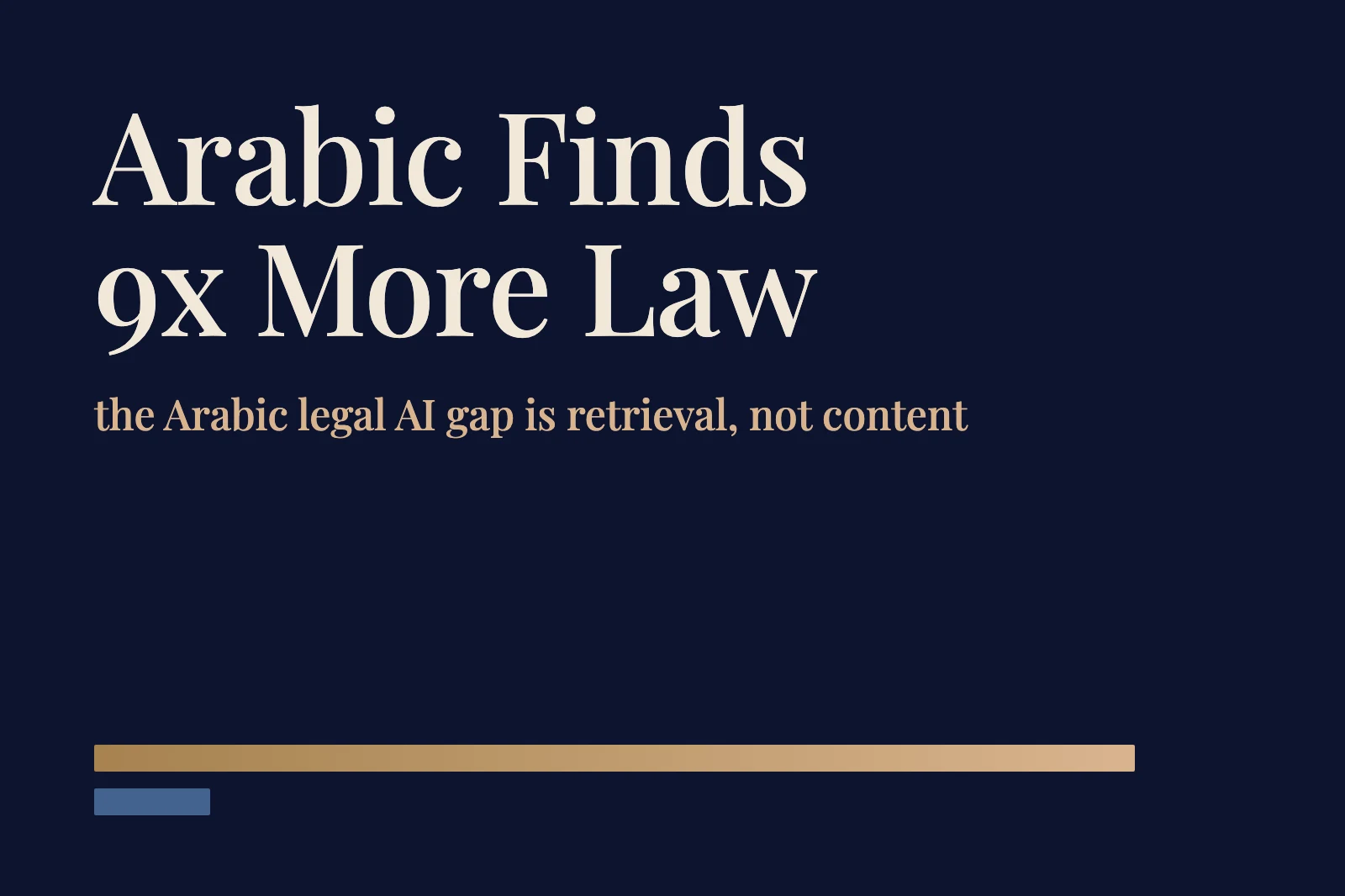
We ran the same legal queries in English and Arabic. Arabic returned 9x more primary law plus silent wrong-country errors. The gap is retrieval, not content.

Gulf courts adopted AI before most US bars wrote rules, yet Arabic legal data stays scarce. Who's building, who's buying, and where the gap really is.

Legal tech in 2026: who got funded (Ivo $55M, Lawhive $60M, HAQQ $3M), who consolidated, what courts sanctioned, and why MENA is the regulatory lab.

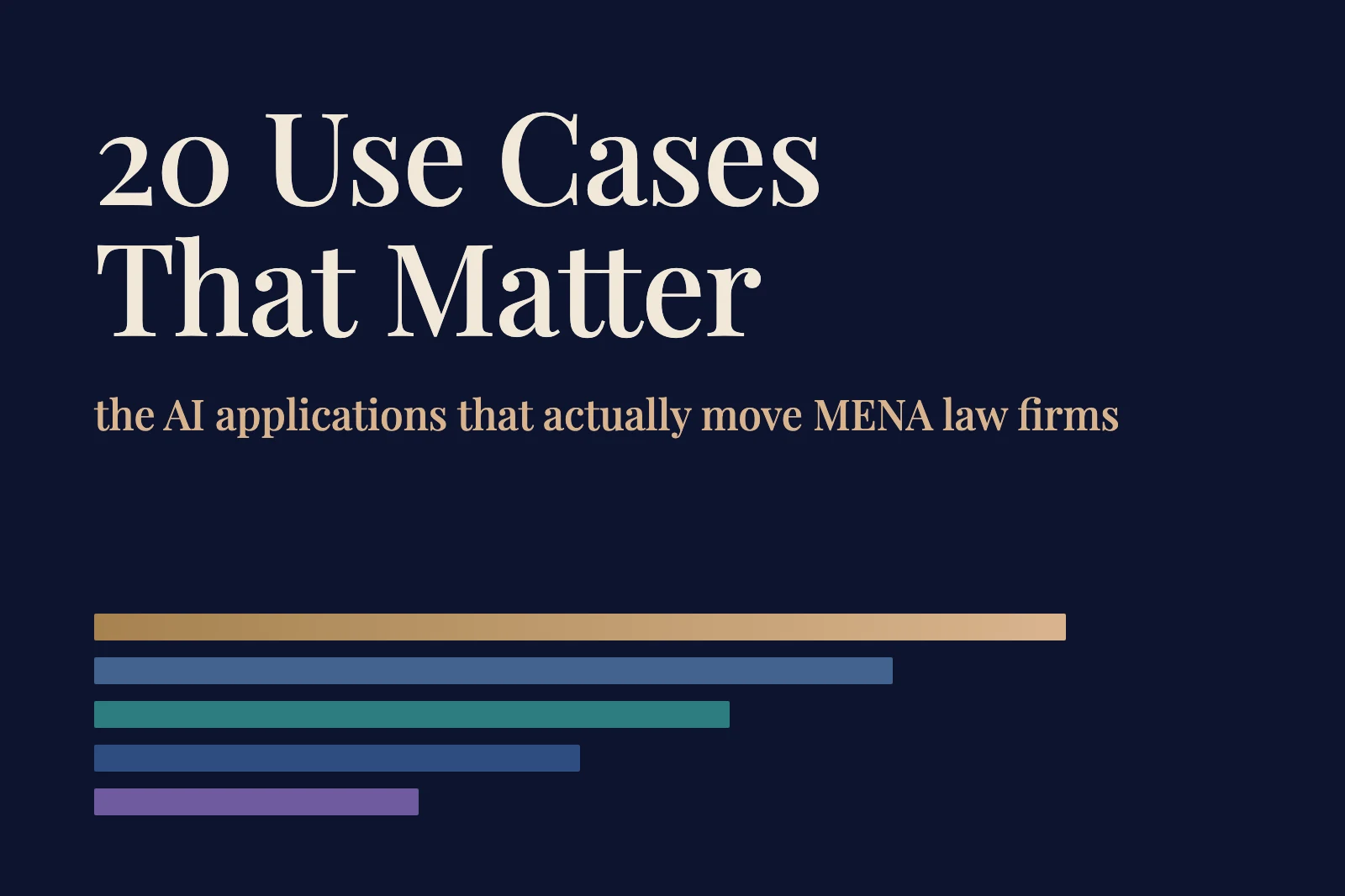
Most AI use cases in law firms do not produce competitive advantage. Here are 20 that actually move the needle - and why they fail without structured data.

Oman's legal reforms in plain terms: 100% foreign ownership under Royal Decree 50/2019, the Personal Data Protection Law, and Vision 2040's framework.

A curated calendar of the legal and legal-tech events worth attending in 2026 - Legalweek, ABA TECHSHOW, ClioCon, plus the MENA rooms most lists miss.