Justinian®
The proprietary Legal AI engine behind HAQQ Chat, eFirm and the mobile app, built for lawyers and for everyone who is not one.
Justinian establishes what you are actually asking, which jurisdiction governs it, and what the law says, before a single word is drafted. Built for work that has to be reviewed, cited and signed.

- Every legal claim
- CitedEvery legal claimGrounded in retrieved law. Where the law is unsettled, Justinian flags it rather than resolving it for you.
- Major practice areas
- 24Major practice areasDrafting, review, research, cross-border analysis and study, one engine, not five tools.
- Highest of 19 models, our own benchmark
- 49 / 50Highest of 19 models, our own benchmarkTop score on our published cross-model benchmark, one part of the 250 complex legal tasks Justinian is evaluated on.
- Long-horizon tasks
- 1,372Long-horizon tasksWhole matters run end to end and graded all-pass: every step has to pass, partial credit does not count.
Everything behind a single answer
One answer runs on a full stack: product surfaces, security and governance, frontier models, grounded data, and jurisdiction-aware reasoning across MENA, Europe and the US.
Why Justinian?
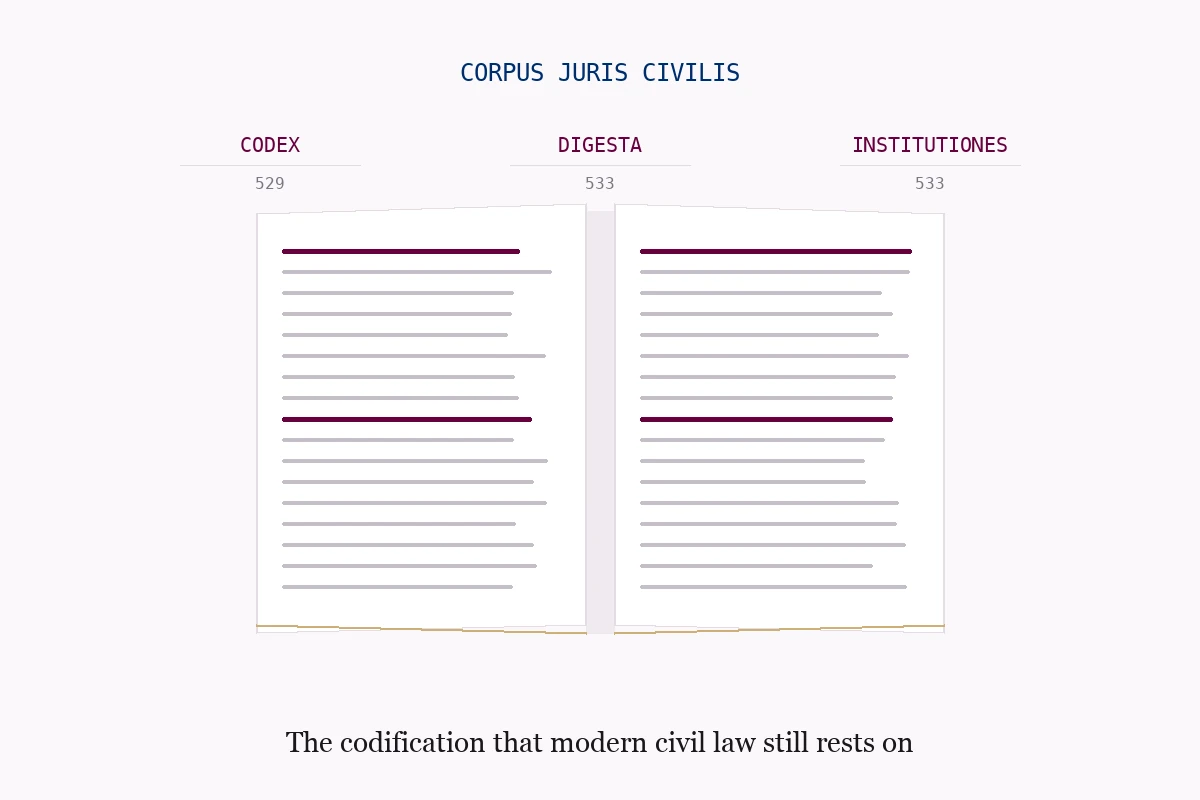
The name Justinian honors Emperor Justinian I of the Eastern Roman Empire, the architect of history's most influential legal codification. Where Emperor Justinian unified Roman law for an empire, our Justinian engine unifies legal intelligence for the practitioner.
“The empire's legal system needed repair. There existed three codices of imperial laws and other individual laws, many of which conflicted or were out of date.” - On Emperor Justinian's mandate, 527 AD
A frontier model is a component, not the product
Everything above describes how Justinian® works. This is what it is for. ChatGPT and Claude give you access to an LLM. HAQQ gives you the legal system built on top of one, and most of what makes a legal answer usable happens outside the model.
- A general model returns the most plausible continuation of your prompt.
- Justinian® resolves the legal issue, the governing jurisdiction and the language that law is written in before a model is called.
- A general model answers from what it absorbed during training.
- Justinian® retrieves the statutes, case law and matter documents that actually apply, and cites what it used.
- A general model is one vendor's product, and you inherit that vendor's choices.
- Justinian® routes each kind of legal work to whichever model suits it, so adopting a better one is a configuration change.
A third-party frontier model still performs the final generation, and we would rather say so plainly than imply we trained our own. The orchestration, retrieval, jurisdiction logic, memory and guardrails around it are ours, and that is the layer carrying the legal value.
The full argument, with both pipelines drawnHAQQ within the Legal AI Landscape
Every category on the map, from general-purpose models to full-stack legal platforms.





Eleven categories, one map. HAQQ is the only one in the full-stack, legal-specialized corner. Click any node to drill in.
Limitations
Despite the leap in capabilities, the engine exhibits several limitations common to legal generation engines. Understanding these boundaries is essential for responsible use.
Input Dependency
Incomplete or incorrect facts produce incomplete or incorrect analysis. The engine cannot independently verify factual claims, quality in determines quality out.
- InNot connected
Knowledge Boundaries
Cannot access information outside training data and connected sources. Real-time legal updates require explicit integration with your firm's data.
Professional Review Required
Every output requires review by a qualified professional. This is not a limitation to be solved but a design principle.
Safety & Professional Responsibility
Disclosure
AI-generated content is always labelled, so you always know what came from the engine.
Competence
It works inside legal domains and refuses to speculate outside them.
Confidentiality
Encryption in transit and at rest, isolation per organization, and no training on your data.
Oversight
Every output needs professional review before it reaches a client or a court.
Legal responsibility always remains with the lawyer. This is intentional.
Read our security practicesAI Research Behind Justinian
Deep dives into the architecture, experiments, and benchmarks that power our legal AI engine.

Confidentiality Is the Next Hallucination: AI Client Confidentiality for Lawyers
Fake AI citations went from curiosity to a docket of thousands. AI client confidentiality is on the same curve. The triggers, our forecast and four controls.
Read More
Primary sources decide whether lawyers trust legal AI: a 10-minute test
A legal AI citation is worth the text behind it. A 10-minute test for any tool, plus where official laws live across nine GCC and MENA jurisdictions.
Read More
How to Test a Legal AI: 5 Trap Questions, 4 Frontier Models
We asked four frontier models for court judgments backing an article that doesn't exist. Two declined. Two named 16 between them. Here are the five tests.
Read More![Stop writing [CLIENT]: how to anonymize a document before you give it to AI](/_next/image?url=%2Fog%2Fblog%2Fredaction-tools-for-lawyers.webp&w=3840&q=75)
Stop writing [CLIENT]: how to anonymize a document before you give it to AI
Swapping names for [CLIENT] is one of the two anonymization methods a September 2026 study found hurt AI output most. Keep entities distinct and typed instead.
Read More
We tested nine AI systems on a Lebanese waqf matter. Most got the decisive article wrong.
One real Arabic client instruction, a 1947 Lebanese statute, and every citation checked article by article. Justinian V2 scored 88. The highest-scoring general model reached 82.
Read More
Claude Opus 5.5 for legal work: we ran our own benchmark and could not pick a winner
We put Opus 5.5, Opus 5 and Fable 5.1 through ten lawyer-grade prompts and 120 blind verdicts. They finished four verdicts apart, in a loop. Only price separated them.
Read More
- Measured
Top legal tasks by AI usage
The legal tasks lawyers most often hand to AI, ranked by share of usage.
View the data - Measured
Cross-model legal benchmark
Every legal AI model we tested, scored out of 50 across legal task categories.
View the data - Measured
AI autonomy scores by task
How autonomously AI can handle each legal task, and where it must stop.
View the data - Measured
Tasks that still need a human
The share of each legal task professionals say still requires human judgment.
View the data - Measured
Time savings by legal task
Median hours saved per task when a lawyer works with AI rather than alone.
View the data - Illustrative
Risk and hallucination rates
Estimated error rates across legal tasks, highest for citation and jurisdiction work.
View the data
Show all 25 Labs studies
- Legal AI Request Clusters
- Prompt Type Distribution
- Work vs. Personal Use Cases
- Prompt Engineering Impact
- AI vs. Human Education Level
- Legal Productivity Benchmarks
- Legal AI Demand by Country
- Global Coverage Map
- Legal AI Market Growth
- Legal AI Investment & Funding
- Competitive Landscape Map
- AI Pricing & Monetization
- ROI & Cost Analysis
- Legal AI Adoption Timeline
- Legal AI Maturity Model
- Agentic AI in Law
- Workflow Automation Potential
- AI Spend & Budget Allocation
- Multi-Model Strategy in Legal
- Client Trust & Satisfaction
- Data Security & Compliance
- Workforce Impact & Role Change
- Future Outlook & Projections
- Legal AI Index
- Legal Ontology System
Frequently Asked Questions
Is HAQQ a GPT wrapper?
No. A wrapper passes your question to a public model and returns whatever comes back. Justinian®, the engine behind HAQQ, first runs your question through an orchestration layer we own and host ourselves, which resolves ten decisions before any frontier model is called: what you are asking, what kind of legal work it is, which jurisdiction and language are in play, which tools to use and which safety checks apply. A third-party frontier model then writes the final answer, but orchestration, retrieval, memory, tooling and safety are ours, so changing models is a configuration change rather than a rebuild. Our benchmarks, including the runs where another model scores higher, are published in HAQQ Labs.
How is Justinian® different from ChatGPT?
ChatGPT is a general-purpose language model that generates plausible-sounding text. Justinian® is a legal AI engine: before any general model is called, it establishes what you are actually asking, which jurisdiction applies, what language the governing law is in, and what the request needs. The general model then runs on a question that has already been framed. It applies legal rules to facts, respects jurisdictional boundaries, cites retrieved sources, and produces structured, client-ready deliverables.
Does Justinian® cite real case law?
Yes. Justinian® searches verified legal databases and authoritative sources before answering. Every citation is traceable and verifiable. When sources conflict or the law is ambiguous, Justinian flags the uncertainty rather than presenting a confident but wrong answer.
Can Justinian® draft contracts in Arabic?
Yes. Justinian® drafts natively in Arabic, English, French, and other languages with full RTL support. It understands legal nuance in each language and can produce bilingual contracts while maintaining legal precision across both versions.
What jurisdictions does Justinian® support?
Justinian® reasons across MENA, Europe, the US and international arbitration frameworks including ICC and UNCITRAL, and it drafts in English, Arabic and French. Depth varies by jurisdiction, because it depends on how well the source law is digitised and how much of it is public. Rather than quote a single global number, we would rather answer the question for the specific jurisdiction you work in.
Is Justinian®'s reasoning auditable?
Yes. Every Justinian® output includes a transparent reasoning chain, you can see which rules were applied, which sources were consulted, and how the conclusion was reached. This auditability is critical for professional accountability and client trust.
What happens before Justinian® answers a question?
Your question does not go straight to a general-purpose model. It first passes through a step we own and control, which establishes what you are actually asking, what kind of legal work it is, which jurisdiction is in play, what language the governing law is written in, and the facts inside your request as structured data. Only then does the general model run, and it arrives with the question already framed rather than guessing at it.
Why does doing work before the model call make the answer better?
Two reasons. A model's context window is finite, so anything loaded unnecessarily competes for attention with your actual document. And a model handed structured facts instead of a wall of prose spends its budget on legal reasoning rather than on parsing what it was given. The second effect is larger than most people expect, and it is why the same general-purpose model produces better legal work inside Justinian® than inside a simple wrapper.
Which AI model does Justinian® use, and are you locked into one vendor?
We deliberately do not build on a single vendor. A third-party frontier model performs the final generation, but every layer that carries our value runs independently of any particular one: orchestration, tooling, retrieval, memory and safety. Justinian® is architected to route different kinds of legal work to different models, so if a better or cheaper model appears, adopting it is a configuration change rather than a rebuild.
Can Justinian® read scanned documents and photographs?
Yes. We treat document intake as a first-class engineering problem rather than a preprocessing afterthought, because a large share of legal work arrives as a scan, a photograph of a stamped page, or a PDF that was printed and re-scanned crooked. An error introduced at that stage cannot be recovered later: the system would reason impeccably about the wrong clause number.
Does Justinian® remember my previous matters?
Yes. Justinian® holds the relationships between your matters over time and draws on them when a question calls for it, rather than simply replaying recent messages back into the prompt. That is what lets it recognise that the counterparty in a contract you are reviewing today is the same one from a dispute two months ago.
Does Justinian® hallucinate?
Any system built on a language model can produce a wrong answer, and any vendor who tells you otherwise is not being careful with words. What good architecture does is make wrongness rarer and detectable: legal claims are generated against retrieved sources, every claim carries a citation you can open, and where sources conflict or the law is genuinely ambiguous Justinian® flags the uncertainty instead of resolving it for you. It is built to be reviewed by a professional, not to replace one.
How do I tell whether a legal AI product is just a ChatGPT wrapper?
Four questions in a demo, and they work on any vendor including us. Ask it something outside law: a wrapped general model will usually answer a medical question. Ask the same legal question in two languages: if the substance changes, language is handled after the reasoning rather than before it. Upload a badly photographed document. And push it toward an unsettled area of law, where a system built for professional work will tell you the ground is uncertain instead of producing a confident answer.
How is Justinian® evaluated?
Against legal-specific benchmarks rather than general ones, because a model that scores well on general reasoning can still be useless on a clause. Clause-level validation, jurisdictional accuracy and continuous feedback from practising lawyers drive what the engine does before and around every model call: what gets retrieved, which capabilities run, and what gets flagged for human review. The results are published rather than described, including the ones where a frontier model beats us.
How do I know a number on this page is real?
Every figure we publish declares how we know it. Measured means it comes from our own usage data or our own benchmark run. Cited means it is a third-party finding, linked to its source. Illustrative means it is a directional scenario, and it carries a badge saying so, including on the worked examples further up this page. If a number does not say which of the three it is, treat that as a defect and tell us.
Do you publish results where another model wins?
Yes, and you should be suspicious of any legal AI vendor who does not. A benchmark that its author always wins is marketing, not evaluation. Our published runs include tasks and categories where a frontier model scores above us, because a buyer needs to know where the tool is strong and where it is not before they rely on it in front of a client.