Skip to content
    HAQQ Legal AI Platform Logo
    • Enterprise
    • Pricing
    Log inSign up for free
    Sign up for freeBook a Demo
    1. Home
    2. Blog
    3. Agentic Legal AI: Why Multi-Agent Systems Beat Single LLMs
    Back to BlogAI & Legal Tech

    Agentic Legal AI: Why Multi-Agent Systems Beat Single LLMs

    Why multi-agent architectures beat single-LLM tools at legal work: task routing, jurisdiction-aware retrieval, citation verification, structured output.

    May 19, 2026
    14 min read
    |
    Issam Amro
    Agentic Legal AI: Why Multi-Agent Systems Beat Single LLMs

    Legal AI is not one problem. It is a stack of problems — drafting, reasoning, citation, compliance, jurisdictional routing — and solving one does not solve the others.

    Key facts

    • "State-of-the-art in legal AI is not about the model. It is about the system around the model."

    General-purpose LLMs treat legal work like any other text generation task. They produce fluent output. But fluent is not the same as correct, defensible, or structured.

    In this report, we introduce HAQQ's multi-agent legal reasoning architecture and demonstrate that it achieves state-of-the-art results across six core legal AI capabilities, outperforming both general-purpose LLMs and competing legal AI tools.

    This is not a marketing claim. This is an architecture analysis. The data speaks for itself.

    The Problem: Why General LLMs Fail at Legal Work

    Large Language Models are trained on internet-scale data. They learn patterns, not law. This creates five systematic failure modes when applied to legal tasks.

    These are not edge cases. They are structural. A model that hallucinates citations 30% of the time is not 70% useful — it is 100% unreliable, because you cannot know which 30% is wrong without checking everything manually.

    The question is not whether AI can generate legal text. It is whether AI can generate legal text that a lawyer would stake their license on.

    The Evaluation Landscape

    Most legal AI benchmarks test narrow capabilities: can the model summarize a contract? Can it extract a clause? These are useful but insufficient.

    Real legal work requires:

    • Multi-step reasoning across complex fact patterns
    • Jurisdiction-aware analysis (a valid answer in DIFC may be wrong in ADGM)
    • Verified citations to actual statutes and case law
    • Structured output that matches professional legal deliverables
    • Temporal reasoning — understanding how law evolves over time
    • Compliance cross-checking against regulatory frameworks

    We evaluated HAQQ across all six dimensions against general-purpose LLMs (GPT-4o, Claude 3.5) and competing legal AI platforms, spanning 500+ legal tasks across 12 jurisdictions.

    Performance Results

    HAQQ demonstrates superior performance across all categories. The system shows particular strength in Legal Reasoning (97%), Citation Accuracy (96%), and Contract Drafting (94%) — areas where general-purpose LLMs historically struggle the most.

    The Delta

    The performance gap is not marginal. It is structural — a direct consequence of architectural decisions, not model fine-tuning.

    Methodology: HAQQ's Architecture

    HAQQ outperforms existing solutions by decomposing legal work into discrete pipeline stages, each handled by a purpose-built agent. This is not prompt engineering — it is legal engineering.

    1. Input Classification & Task Routing

    The first agent classifies the incoming legal task — is it a contract review, a compliance check, a research query, or a drafting request? This classification determines which downstream agents are activated and in what order.

    This is critical because a contract review requires different reasoning patterns than a litigation strategy memo. General LLMs use the same approach for both.

    2. Jurisdiction-Aware Knowledge Retrieval

    The retrieval agent does not search a generic knowledge base. It routes to jurisdiction-specific legal ontologies maintained within the Justinian engine.

    This means:

    • UAE Federal Decree-Law No. 33 of 2021 on Commercial Companies is retrieved when the jurisdiction is UAE onshore
    • DIFC Law No. 5 of 2018 is retrieved when the entity operates in DIFC
    • Saudi Companies Law (Royal Decree M/3) is retrieved for KSA matters
    • Egyptian Civil Code provisions are retrieved for Egypt-based analysis

    General LLMs cannot distinguish between these frameworks. They often merge provisions from different jurisdictions into a single, incorrect answer.

    3. Structured Legal Reasoning

    The reasoning engine applies the TIRO pattern (Trigger, Input, Requirements, Output) to decompose complex legal questions into verifiable logical steps.

    Instead of generating an answer in one pass, the system:

    • Identifies the legal trigger (what event created the legal issue)
    • Maps the relevant inputs (facts, documents, parties)
    • Checks requirements against the applicable legal framework
    • Produces a structured output with supporting citations

    Try HAQQ AI Free

    Experience AI-powered legal drafting and research

    4. Citation Verification

    Every citation produced by the reasoning engine is cross-checked by a verification agent. This agent confirms:

    • The cited statute or case exists
    • The citation is to the correct provision
    • The provision is current (not repealed or amended)
    • The interpretation aligns with established jurisprudence

    This eliminates the hallucination problem at the architectural level, not through prompting hacks.

    5. Structured Output Generation

    The final agent formats the verified analysis into professional legal deliverables — not chatbot responses.

    Output formats include:

    • Legal memoranda with IRAC structure
    • Risk analysis reports with severity grading
    • Contract review reports with clause-level annotations
    • Compliance assessment matrices
    • Client-ready advisory letters

    Capability Matrix

    Beyond raw accuracy, agentic legal AI requires capabilities that general-purpose models simply do not have.

    The distinction between full support (●), partial support (◐), and no support (○) is not about feature lists — it is about architectural capability. You cannot add multi-jurisdictional awareness to a model that was not designed for it.

    Why Architecture Matters More Than Model Size

    The dominant narrative in AI is that bigger models are better. More parameters, more data, more compute.

    In legal AI, this is wrong.

    A 100-billion parameter model that hallucinates citations is less useful than a 7-billion parameter model inside a verification pipeline that catches errors.

    State-of-the-art in legal AI is not about the model. It is about the system around the model.

    HAQQ's architecture demonstrates that purpose-built agent pipelines outperform general-purpose models on every legal metric that matters — even when those general-purpose models are significantly larger.

    Conclusion

    The ability to accurately draft legal documents, verify citations, reason across jurisdictions, and produce structured deliverables is not a "feature" — it is a prerequisite for any AI system that claims to serve legal professionals.

    By moving beyond single-prompt generation and implementing multi-agent verification pipelines, HAQQ transforms the LLM from a text generator into a legal reasoning system — capable of producing work that lawyers can actually use, defend, and build on.

    General-purpose LLMs opened the door. Agentic legal architecture walks through it.

    HAQQ is available for law firms, legal departments, and institutions. Book a demo to see the architecture in action.
    • our open-source civil-law benchmark HAQQ-LAB
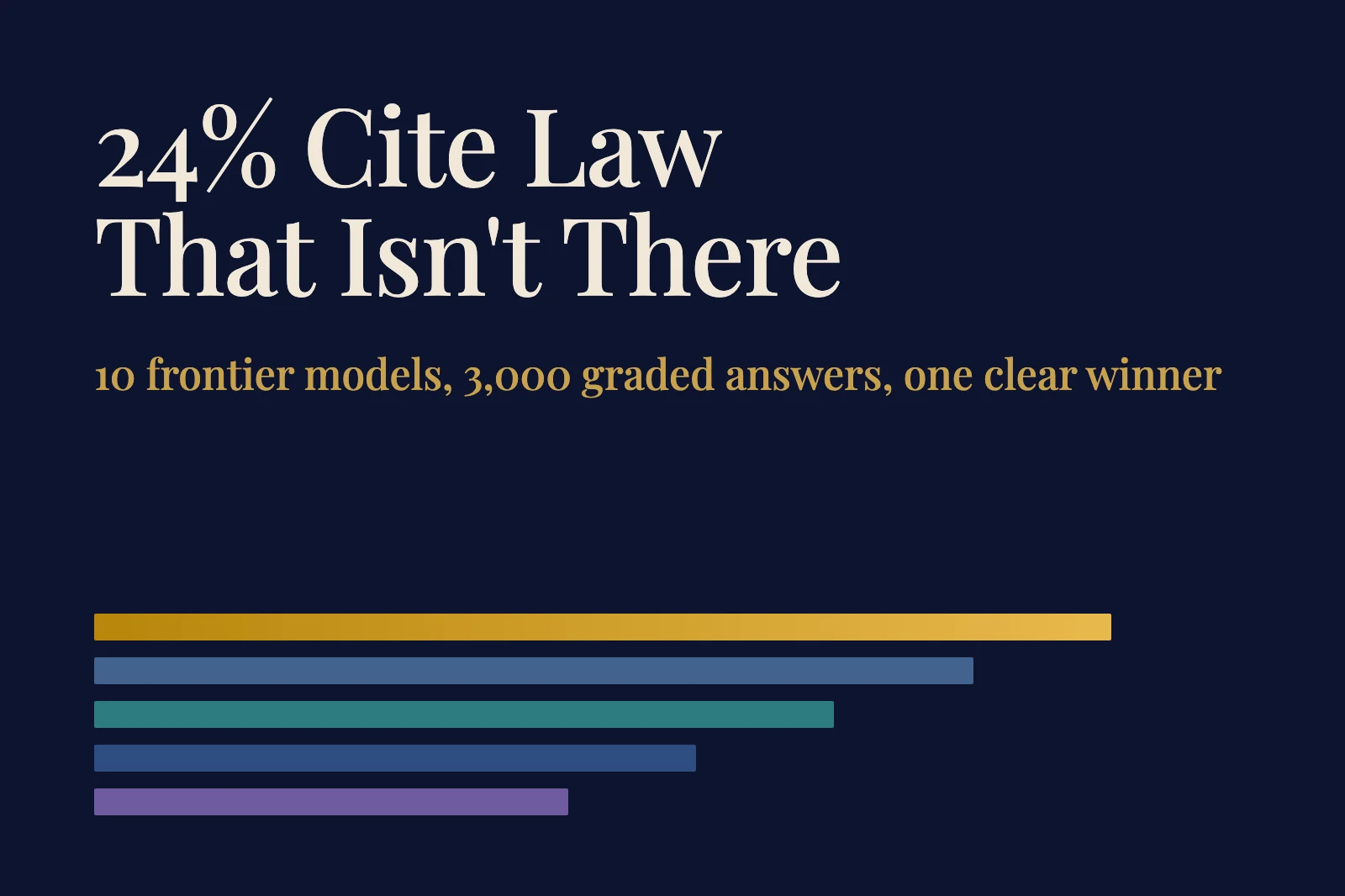
    • 10 frontier models, 3,000 graded answers
    • single-prompt vs 3-agent swarm on a real data room
    • the TIRO decomposition pattern
    • Book a Demo
    • Explore Justinian Engine
    • Learn More About HAQQ eFirm
    I

    Issam Amro

    Legal Content

    Related Resources

    Justinian: purpose-built legal AILegal AI ChatContract review with AI

    Related Posts

    Best AI for Legal Work in 2026? We Graded 3,000 Answers

    Best AI for Legal Work in 2026? We Graded 3,000 Answers

    Governance by Construction: AI Guardrails You Can't Bypass

    Governance by Construction: AI Guardrails You Can't Bypass

    ChatGPT for Lawyers in 2026: What It Does Well and Where Legal AI Wins

    ChatGPT for Lawyers in 2026: What It Does Well and Where Legal AI Wins

    Frequently asked questions

    What is agentic AI in legal work?

    Agentic AI in legal work describes systems where multiple specialised AI agents collaborate on a task - one retrieves authority, one drafts, one critiques, one cite-checks, one summarises - rather than a single chat model answering a prompt. It is the architecture pulling ahead in 2026 because recall and reliability on complex matters are materially higher.

    How is agentic legal AI different from ChatGPT?

    ChatGPT is one model answering one prompt. Agentic legal AI decomposes the work across specialised agents with their own retrieval, tools and verification steps. The result is higher recall on cross-document issues, better citation grounding and a clearer audit trail of how the answer was produced.

    Is agentic AI ready for production legal work?

    Yes, with human supervision. Leading agentic legal AI systems in 2026 are deployed for contract review, due diligence, legal research and litigation support across firms of all sizes. Production-readiness requires no-training data contracts, audit logs, jurisdiction-aware retrieval and named-lawyer approval at every gate.

    What are the leading agentic legal AI platforms in 2026?

    The most evaluated agentic legal AI platforms in 2026 include HAQQ (integrated legal operating system with multi-agent reasoning), Harvey (enterprise Am Law focus), Legora (collaborative workspace), and CoCounsel by Thomson Reuters. Architecture and depth of agent orchestration vary significantly.

    What are the risks of agentic legal AI?

    Higher capability brings higher stakes. Risks include cascading errors across agents, opaque reasoning chains, prompt injection across document boundaries and over-trust by lawyers in confident-sounding outputs. Mitigation is layered: structured outputs, audit logs, citation verification and human approval gates.

    How does HAQQ implement agentic legal AI?

    HAQQ orchestrates specialised agents for retrieval, drafting, critique, citation verification and summarisation, grounded in jurisdiction-aware case law and statutes, with structured outputs and audit logs at every step. Named-lawyer approval is required before any output leaves the workspace.

    What's Next?

    Try HAQQ AI Free

    Experience AI-powered legal drafting and research

    Calculate Your ROI

    See how much time and money HAQQ saves your firm

    Browse 300+ Legal Prompts

    Ready-to-use prompts for every legal task

    Back to Blog

    Previous article

    Prompt Engineering for Lawyers: 7 Principles That Hold Up

    Next article

    The 10 Types of Legal Work and Why AI Treats Each One Differently

    14 min read

    Share this

    Legal AI for Everyone

    HAQQ enables anyone to draft, research, review and manage legal work.

    HAQQ across all devices
    ++++
    HAQQ Legal AI Platform Logo

    Your Legal AI Twin & Practice Management System for drafting, billing, and winning.

    Download on theApp StoreGet it onGoogle Play

    Product

    • HAQQ Legal AI Chat
    • HAQQ eFirm
    • Justinian AI Engine
    • Enterprise
    • Mobile App
    • HAQQ eBar
    • HAQQ eWallet
    • Compare Us
    • Pricing
    • ROI Calculator
    • Security

    Free Tools

    • Free Tools
    • Legal Fee Calculator
    • Billable Hours Calculator
    • Legal Citation Formatter
    • Legal Terms Glossary
    • NDA Generator
    • Contract Clause Checker
    • Privacy Policy Generator
    • GDPR Compliance Checklist

    Resources

    • Blog
    • Legal AI Ontology
    • Legal AI Index
    • Learn Legal with AI
    • Prompt Library
    • Legal AI Skills
    • The Litigation Game
    • Clause Library
    • Document Library
    • Students
    • Startup Program
    • VC Program
    • Partnership
    • Press & Events
    • HAQQ Academy
    • Changelog
    • Status
    • FAQ
    • Contact
    • Support

    Company

    • Meet the Team
    • Careers
    • Solutions
    • Resources

    Solutions Directory

    • All Solutions
    • By Role
    • For You
    • By Use Case
    • By Feature
    • By Firm Size
    • By Country
    • By City
    • Specialized

    From the blog

    • Claude for Word launched. Here's what lawyers actually need to know.
    • Docling Python: A Practical Guide to Processing Files in 2026
    • Claude Didn't Kill Legal Tech. It Exposed the Weak Layer.
    • Benchmark report: best AI for legal work
    • View all articles

    Legal

    • Terms of Service
    • Privacy Policy
    • Cookie Policy
    • Data Processing

    ├── locales/ ar en fr es it de pt

    ├── contact/ info@haqq.ai

    └── status/ operational · grounded

                                                                          .
                                                             ..... .....  ..   .
                                                      .      ......:-:............    .
                                             .       ............    ..       ....    .
                                             .    ..............:.:::::.:...:...............    .
                                       .   ..............     ..:::::=-=-::::..       .......... .
                                     ............    ....:--::----------::::::------:.        . ..
                             .  ..................:::::::::-::-----::::...............:::::  ... ... ...
                    .   ..........................::--:::::.:::...:...................:::::......................
             .     ...........       .::...-==-::::::::.......  .   ... .  .       ... .. ...:-:-..:--..       .  .............  ..
    .     .....:-::....      .:::::::::--:::--........ .............                  ....        ........--:........    ......   .       .
    ....::..........:::...::.:::::::...-...........................                   ....    ..................::... ................   ...
    ..::::......   .:-====-::=::::::..................                                                    . ....:::...:::..... ..............
    .
    .....:::::::::::::::::::::::::::::::::::::::::::::::::::::::::::::::::::::::::::::::::::::::::::::::::::::::::::::::::::::::::::::::::.
     ....:::::::::::::::::::-::::=-::::-:::::-::::-:::::--:::-=-:::-=-:::-=-::::-=:::==::::=::::-=-:::-=-:::--::::--:::-=-::::-:::::::::::.
      .-:::::..::::::::::::::::::::::::::::::::::::::::::::::::::::::::::::::::::::::::::::::::::::::::::::::::::::::::::::::::::::---=-:
         :::...              .        .                 .        ..    .   ..        .    .   .   .. ......... .     .....   ....:---=:
         .........................................................................................................................:-:-.
                .....  ............................  ................................................................     .... .   ..
                                                                                                      ...            .....    ......
         ..                                                                                            .             .....    .......
         ....                                                                                        .          ....               ..
        .  ..........................................................................................:..........::::...................
          .. .... ..... .::::::-----------::::::. .........  :---------------------:.  ......... .:--------------:::.  .........    .
           ...........:::::::::----------:::::::::........::::--------------------::::.........:::::-------------:::::.........:::::.
            ..........:::::::::::--------------=-:.......:::---------------------=::::.........::-=-------------=:::::.........:::::
                  . ...::::::::::-----------------.   . .:::---------------------:::::.      ...:---------------::::::.      ..:::.
                  .....:::::::::------------------.   .....:---------------------:::::.      ...:---------------::::::.      ...:::
                  .....::.:::::-=-:--------------:.   .....::--------------------:::::.      ...:--------------:=:::::.      ...:::
                  .....:...:::::::::-------:::::::.   .....:::------:::::::------::::..     ....:-----------:::::--::..      ...:::
                  .....:..:::::::::::::::-:::::::.     ....::----::::::::::-::----:::..      ...::::---::::-------:::..      ...:::
                  ..........::.::::::::::.........     ....::----::.........::----::...      ...::::....:::------::::..      ...:::
                  ..........::.::::::::::.             ....::-----=:        ::::::::...      ...::--   :=-=------::::..      ...::.
                  ..........::.::. ..::-               ....::::::            :-:.:::..       ...::.       ::::---:::..       ...:::-
                  ..........::.::...:::-.              ....::::::            ....:::..       ...::.       ::::---:::..       ...:::-
                 ...........::.::...:::-.              ....::::::            ....:::..       ...::.       ::::---:::..       ...:::-
                  ..........::.::...::::               . ..::::::            ....:::..       ...::.       ::::---:::..       ...:::-
                  ..........::.::...::::               .... :::::            ::..:....       ...::.       :::---::....       ...:::.
                  ..........:.......::::               ....::::::            .........      ....::.       ::::--:::...       ...:::.
                  ..........:.......:::=.             .....::::::            .........      ....::.       :::---:::...       ...:::.
                  ..........:.......:::-              .....::::::             ........       ...::--      .::::-:::...       ...::::
                  ..........:.......:::--.            .....::::::            .........       ...:::.      .::::-:::...       ...::::
                  ..................::::-.            .....::::::            .........      ....::..      ..:::-:::...       ...::::
                  ..................::::-.            .....::::::             ........      ....:::.      ..:::-:::...       ...::::
                  ..........-.......::::-.            ......:::::             ........       ...::..      ..:::-:::...       ...::::
                  ..................::::-.            ......:::::             ........       ...:::.      ..:::-:::...       ...::::
                  ..................:::::.             .....:::::             ........       ...::::      ..:::-:::...       ...::::
                  ..........:.......:::::.            ......:::::             ........      ....::::      .::::-:::...       ...::::
            .     ..........::......:::::.            ......:::::             ........       ...::::      ..:::-:.....       ...::::
            .    ...........::......:::::.            ......:::::             ........       ...::::     ...:::-:.....       ...::::
                 ...........::.::...:::::.            ......:::::             ........       ...::::    :=..:::-:.....       ...::::
                  ..........::.::...:::::.            ......:::::             ........       ....:::    .:..:::::.....       ...::::
                  ..........::.::...:::::.            ......:::::             ........       ....:::    .:..:::::.....       ...::::
                  ..........::.::...:::::.            ......:::::             .......        ....::.    .:..:::::.....       ...::::
                  ..........:::::...:::::.            ......:::::             .......        ....:::    .:..:::::.....       .....::
                  ..........:::::...:::::.            ......:::::             .......        ....:::     ...:::::.....       ....:::
                  ..........:::::....::::.      .     ......:::::.           ........        ....:::   .....:::::.....       ....:::
                  ..........:::::.....:::.            ......::::::          .........       .....::.   ::...:::::... .       ....:::
                   ..........::......  .               .....::....             .. ...        ........................         .....:-.
                   .......................             .............................         ........................         .......
                 ..................                   ................           ..        .........................       ...........
      ....                .                                                                                                             ..
      ....                                                                                                                              ..
      ....                                                                                                                              ....
        ......                  ........................................................              ......       .......   ..          .....
                       .       ..........................................................          .  .....         ......  ...          ..... .
                       ...................................................................         ........         ............................
    ............................................................................................................................................
                                                                                                  ...                      .............    ..
    ............................................................................................................................................
                                      ... ..
                                 ...   .........
                            ....  . ....:::--:::.....
                     .... .  ....:..::::::::............
              . ....   .....::.:::.......            .....:.....
        ...:........:::::::::.....                        .............  .
    ..:...   .::::.:.... .                                         .... ..          ..
       ..............................................................................
     .:::..::::::::::--:::::::::::::::--::-:::-:::-::-:::::-:::-::::::::::-:::::::::.
      .:.  ....................................................................:--:
                                                                                ..
    
       ..                                                                       .
         ...... .............. ...... ..................... ..:.....:::. ......  .
          .  ....::::-----:::::.. ....:------------:...  ...:--------::..   .....
             ..:::::.:---------:   .::------------:::.   ..:---------:::.    .::
              ..:::::-:--------.   ..::-----------:::.    .:--------::::.    ..:
              ....::::::---::::.   ..::---:::::---::.     .:------:::::..    ..:
              ....:..:::::.....    ..::-::.....::--:.     ..::..::---:::.    ..:
              ..........::         ..:::::     .:....     ..:. .:::--::.     ..:.
              ........ .::         ..:::.       .....     .:.    .::-::.     ..::
              ........ .:.          .:::.       .....     .:.    .::-::.      .::
              ........ .:.          ..::.       .....     .:.    .::-:..      .:.
              ........ .::         ..:::.        ...      ...    .::-:..      .:.
              ........ .::          .:::.        ...      ..:.   .::::..      .:.
              ........ .::.         .:::.         ..       :.    ..:::..      .:.
              ........ .::.         ..::.         ..      .:.    ..:::..      .:.
              ........ .::.         ..::.         ..      ..:.   ..:::..      .:.
              ........ .::.         ..::.         ..      ..:.   .::::..      .:.
              ........ .::.         ..::.         ..      .::.  ...:-...      .:.
              ........ .::.         ..::.         ..       .:.  :..::...      .:.
              ........ .::.         ..::.         .       ..:.  ...::...      .:.
              .....::. .::.         ..::.         .       ..:.  ...::...      ...
              .....::. .::.         ..::.         .        .:.  ...::..       .:.
              .....::......         ..:..       .         .... .........      ..:
              ........              ....                  .........   .       ....
                 .


                                                                              .
    ...     ...........................................................................
    © 2026 HAQQ Inc. All rights reserved.Product engineered in-house by HAQQ. Website built with modern web tools.
    humans.txt·lawyers.txt·security.txt
    Failure Analysis

    Why General-Purpose LLMs Fail at Legal Work

    Critical
    Hallucinated Citations
    General LLMs fabricate case references that do not exist
    Critical
    No Jurisdictional Awareness
    Cannot distinguish between DIFC and ADGM legal frameworks
    High
    Flat Context
    Treats all information equally — no temporal or hierarchical reasoning
    High
    No Verification Loop
    Single-pass generation with no self-checking mechanism
    Medium
    Generic Output Format
    Produces chatbot-style responses, not structured legal deliverables
    Legal AI Benchmark

    HAQQ vs General-Purpose LLMs vs Legal AI Tools

    HAQQ Generic LLMs Other Legal AI
    Contract Drafting94%
    Legal Review91%
    Legal Reasoning97%
    Compliance Check89%
    Citation Accuracy96%
    Multi-Jurisdictional92%

    Evaluated across 500+ legal tasks spanning 12 jurisdictions

    Performance Delta

    Where HAQQ Outperforms

    +33%
    Drafting Accuracy
    vs GPT-4o on contract clause generation
    +54%
    Citation Precision
    vs general LLMs on statute references
    +39%
    Reasoning Depth
    vs other legal AI on multi-step analysis
    +54%
    Jurisdictional Coverage
    vs competitors on cross-border tasks
    Architecture

    Multi-Agent Legal Reasoning Pipeline

    📥
    Input Parser
    Classifies legal task type
    Agent 1
    🌍
    Jurisdiction Router
    Routes to correct legal framework
    Agent 2
    📚
    Knowledge Retriever
    Pulls from ontology & precedent
    Agent 3
    ⚖️
    Reasoning Engine
    Applies structured legal logic
    Agent 4
    ✅
    Verification Agent
    Cross-checks citations & accuracy
    Agent 5
    📄
    Output Formatter
    Produces structured deliverable
    Agent 6

    Each agent is purpose-built for its stage — no single-prompt shortcuts

    Capability Matrix

    What Agentic Legal AI Actually Requires

    CapabilityHAQQGeneric LLMsOther Legal AI
    Drafting Accuracy●◐●
    Multi-Jurisdictional●○○
    Citation Verification●○◐
    Practice Context●○○
    Structured Output●◐●
    Temporal Reasoning●○○
    Compliance Checks●○◐
    Audit Trail●○○