
Skip to content
    HAQQ
    • Pricing
    Sign up for free
    Sign up for freeBook a Demo
    Log in
    1. Solutions
    2. Topics
    3. International Cross Border Divorce
    ChatMobile

    HAQQ TOPICS

    Which country's law governs your divorce?

    When spouses, assets, or children span borders, jurisdiction is the first fight. Here is how courts decide which law applies.

    Ask HAQQGet the App
    Ask HAQQExample

    Can HAQQ answer this and show its sources?

    Yes — HAQQ answers in plain language and backs every response with the specific law or clause it used, so nothing is a black box.

    Cited: Primary sources
    Cross-border
    15,000+ law firms100,000+ people80+ countriesLegal AI ChateFirm
    The bottleneck

    What people get wrong

    Jurisdiction is the first fight

    When spouses live in different countries, hold different passports, or own assets abroad, people assume they simply file wherever is convenient. In reality, which court has jurisdiction and which law applies is its own contest — and it can decide the entire outcome before anyone argues the merits.
    What HAQQ does about it

    The short answer

    The short answer

    In a cross-border divorce, courts first decide jurisdiction — which country can hear the case, usually based on residence, domicile, or nationality — and then which law applies to the divorce, the money, and the children. These can point to different countries. The rules vary widely, so confirm locally early.

    Jurisdiction vs applicable law

    Jurisdiction is which country's courts can hear your case; applicable law is which country's rules they then apply. A court in one country can sometimes apply another country's law, and the divorce, the finances, and custody can each be governed differently. Because more than one country may qualify, timing and where you file first can matter — confirm locally.

    Recognition and enforcement abroad

    A divorce or order in one country is not automatically recognized everywhere. Whether your judgment, financial order, or custody arrangement will be enforced in another country depends on that country's rules and any treaties in force. For MENA expats with home-country ties, this matters as much as the divorce itself — always confirm locally.

    The toolkit

    How HAQQ helps

    Private by design (never trained on your data)

    Available inside HAQQ across chat, mobile, and eFirm workflows.

    Real legal citations

    Available inside HAQQ across chat, mobile, and eFirm workflows.

    Available 24/7 in your language

    Available inside HAQQ across chat, mobile, and eFirm workflows.

    From question to cited answer

    How it works

    1

    Map the connections

    List where each spouse lives, their nationalities, where the children are, and where the assets sit. These connections are what courts use to decide jurisdiction.

    2

    Identify the possible forums

    Work out which countries could plausibly hear the case and what law each would apply — then weigh which forum is better for you, since filing first can matter.

    3

    Ask HAQQ, then confirm with counsel

    Ask HAQQ privately to map your cross-border options in your language, then confirm jurisdiction and enforcement with lawyers in the relevant countries. This is legal information, not legal advice.

    FAQ

    Which country's law applies to my divorce?

    Courts decide jurisdiction first, then applicable law, usually from residence, domicile, or nationality. The two can point to different countries, and rules vary widely — confirm locally.

    Can I choose where to file for divorce?

    Sometimes more than one country qualifies, and where you file first can matter. But you can only file where a court has jurisdiction over your case — confirm with local counsel.

    Will my divorce be recognized in another country?

    Not automatically. Recognition of a divorce or order abroad depends on that country's rules and any applicable treaties. Check enforcement in every country that matters to you.

    What about children who live across borders?

    Cross-border custody and relocation raise their own rules, sometimes under international conventions. The outcome depends on the children's habitual residence and the countries involved — confirm locally.

    Next

    Related solutions

    Topics
    ChatMobile

    Divorce for expats in the UAE

    Personal-status law or the civil track — how to tell which applies to you, and what each one means for custody and money.

    Read the guide
    Topics
    ChatMobile

    UAE civil divorce under Decree-Law 41 of 2022

    Federal Decree-Law No. 41 of 2022 created a civil track: no-fault divorce, a joint-custody default, and statutory financial provisions.

    Read the guide
    Topics
    ChatMobile

    Relocating with children after divorce

    A move that affects the other parent's time usually needs consent or court approval. Here is the standard.

    Read the guide
    Keep exploring

    Browse other solutions

    By roleBy use caseFeaturesBy firm sizeBy countryBy cityFor individualsSpecialized

    Join 15,000+ law firms using HAQQ

    Private, cited legal AI across chat, mobile, and eFirm.

    Start FreeSee It In Action
    SOC 2 controlsPrivate by designMulti-jurisdiction

    Legal AI for Everyone

    HAQQ enables anyone to draft, research, review and manage legal work.

    HAQQ across all devices
    HAQQ Legal AI Platform Logo

    Your Legal AI Twin & Practice Management System for drafting, billing, and winning.

    Download on theApp StoreGet it onGoogle Play

    Product

    • HAQQ Legal AI Chat
    • HAQQ eFirm
    • Justinian AI Engine
    • Enterprise
    • Mobile App
    • HAQQ eBar
    • HAQQ eWallet
    • Compare Us
    • Pricing
    • ROI Calculator
    • Security

    Free Tools

    • Free Tools
    • Legal Fee Calculator
    • Billable Hours Calculator
    • Legal Citation Formatter
    • Legal Terms Glossary
    • NDA Generator
    • Contract Clause Checker
    • Privacy Policy Generator
    • GDPR Compliance Checklist

    Resources

    • Blog
    • Legal AI Ontology
    • Legal AI Index
    • Learn Legal with AI
    • Prompt Library
    • Legal AI Skills
    • The Litigation Game
    • Clause Library
    • Document Library
    • Students
    • Startup Program
    • VC Program
    • Partnership
    • Press & Events
    • HAQQ Academy
    • Changelog
    • Status
    • FAQ
    • Contact
    • Support

    Company

    • Meet the Team
    • Careers
    • Solutions
    • Resources

    Solutions Directory

    • All Solutions
    • By Role
    • For You
    • By Use Case
    • By Feature
    • By Firm Size
    • By Country
    • By City
    • Specialized

    From the blog

    • Claude for Word launched. Here's what lawyers actually need to know.
    • Docling Python: A Practical Guide to Processing Files in 2026
    • Claude Didn't Kill Legal Tech. It Exposed the Weak Layer.
    • Benchmark report: best AI for legal work
    • View all articles

    Legal

    • Terms of Service
    • Privacy Policy
    • Cookie Policy
    • Data Processing
    • Localesar en fr es it de pt
    • Contactinfo@haqq.ai
    • Statusoperational·grounded
    HAQQ Legal AI

    Built for everyone with a legal question

    Legal AI accessible for everyone, in 80+ countries and 7 languages.

    © 2026 HAQQ Inc. All rights reserved.Product engineered in-house by HAQQ. Website built with modern web tools.
    humans.txt·lawyers.txt·security.txt
    Connected Intelligence
    Legal AssistantAWhat is the term of this NDA?NDA · Vendor.pdfThe term is 3 years from signing,effective 1 Mar 2024, expiring28 Feb 2027.ADoes confidentiality survive termination?Yes — obligations continue for 2years after expiry, until 28 Feb 2029.Can this agreement be terminated early?
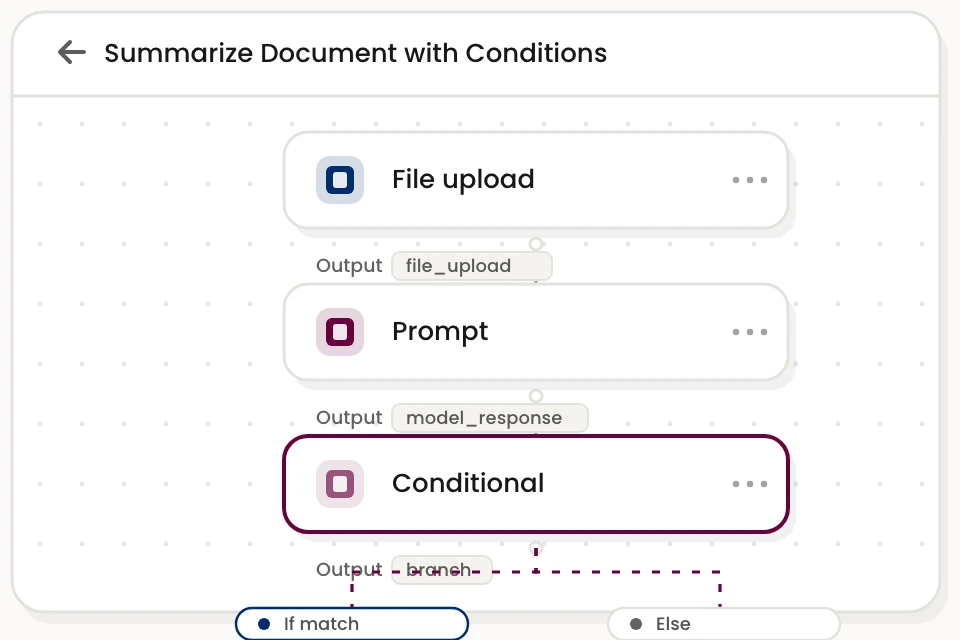
    Summarize Document with ConditionsFile uploadOutputfile_uploadPromptOutputmodel_responseConditionalOutputbranchIf matchElse