
Skip to content
    HAQQ
    Se connecter
    Contacter les ventes
    Essayer HAQQ
    Essayer HAQQ
    1. Accueil
    2. Blog
    3. Automatisation documentaire par IA pour petits cabinets : quoi acheter et quoi éviter
    Guides & Tutoriels

    Automatisation documentaire par IA pour petits cabinets : quoi acheter et quoi éviter

    Deux produits différents sont vendus sous le nom d'automatisation documentaire, et les petits cabinets achètent souvent le mauvais. La distinction qui détermine l'achat, un pilote en cinq vérifications, et ce que vaut un brouillon qui connaît le dossier.

    Nicolas DawalibiNicolas Dawalibi|
    16 septembre 2026
    6 min de lecture
    Automatisation documentaire par IA pour petits cabinets : quoi acheter et quoi éviter

    Document automation has been sold to small firms for twenty years, and most small firms still draft from the last similar file. The reason is structural. Most tools in this category produce nothing until someone builds a template library first, and in a four-lawyer firm that is nobody's job.

    Short answer. There are two different products both called document automation, and buying the wrong one is the common expensive mistake. Classic template engines assemble a document from questionnaire answers and conditional logic, and they need a template library built and maintained first. AI drafting produces the document from the matter and your existing precedents, with no logic tree to author. A small firm usually wants the second, with the first added later for the two or three documents it produces at real volume. HAQQ sits in the second category: Legal AI Chat drafts and reviews, eFirm holds the matter so the draft arrives with the parties, dates and governing law already in it, and the clause and template libraries give you a starting corpus you did not have to build.

    The distinction that decides your purchase

    Automated drafting: files and matter data in, a first draft out.

    Three categories get sold under overlapping names. Separate them before you look at any pricing page.

    • Document assembly, sometimes called template automation. You build a template, add conditional logic, and answer a questionnaire. The output is deterministic and identical every time. Excellent for a form you produce fifty times a month. It does nothing on the first day, because the template does not exist yet.
    • Document management. Storage, version control, full-text search, access permissions. It organises documents you already have. It generates nothing. Buying this when you needed generation is the most common miss in legal tech procurement.
    • AI drafting. The system produces a draft from an instruction plus the matter file plus your precedents. No template to author, no logic tree. The output varies, which is why every draft is a first version for a lawyer to check.

    A small firm's real constraint is that nobody has three weeks to build a template library. That is the argument for starting with AI drafting and adding assembly later, for the narrow set of documents where volume actually justifies the build.

    Why a draft that knows the matter beats a draft that does not

    A matter workspace, where the parties, dates and governing law already live.

    This is the part that separates a legal platform from a general chat window, and it is easy to underrate until you have used both.

    A draft generated in a standalone chat starts empty. You paste in the party names, the dates, the governing law, the position from the last round. A draft generated on the matter already has them. Over a year of small documents, that difference is most of the time saving, and it is also where most of the error risk sits, because retyping a party name is how the wrong entity ends up on a signature page.

    HAQQ's eFirm holds matters, contracts, documents, hearings, tasks, calendar, financials, KYC, leads and email. Legal AI Chat drafts against that. Every chat, draft and document lives on the matter. On the eFirm Purple tier there is also a Legal AI Digital Twin that writes in the firm's voice, so drafts come out in your house style.

    The starting corpus problem, and what HAQQ publishes

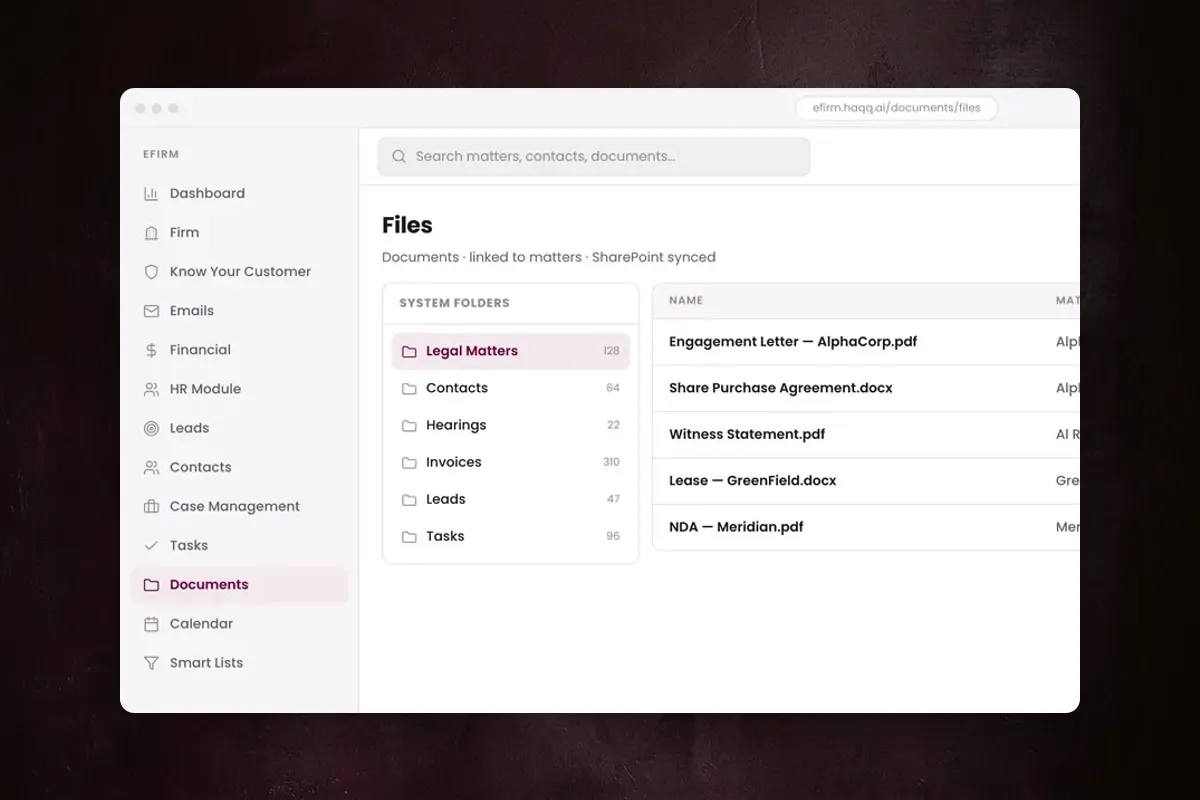
    A document library with AI actions attached, which is what a starting corpus looks like in practice.

    Every automation tool asks the same first question: where do the templates come from. For a firm with no library, that question is the whole barrier.

    HAQQ ships with a starting corpus. There are 70 document templates, 738 real-world clauses in the clause library, and 394 legal prompts across 23 practice areas. There are also 20 free tools that need no signup, including an NDA generator and a contract clause checker, which are a reasonable way to see the output quality before any subscription.

    That corpus is a starting point. Your own executed documents still have to go in, and loading them is the first thing to do after buying anything in this category. Your fallback positions are the asset, and no vendor library contains them.

    What to test before you buy

    Grade each check complete, partial or missing, and keep the score.

    Ask each vendor for a pilot on your actual documents. Refuse the scripted demo. Five checks, each graded pass, partial or fail.

    • Time to first usable draft. Start the clock at signup. How long until the tool produces something a lawyer would send to a client after review. If the answer requires building a template first, that build time is part of the number.
    • Use your own precedents. Upload three of your own executed documents and ask for a fourth in the same style. Check whether your defined terms, your numbering convention and your fallback positions survive.
    • Matter data flow. Does the draft pull parties, dates and governing law from the file automatically, or do you retype them. Retyping is where the errors are.
    • The edge case. Give it a document with an unusual structure: a side letter, an annex in a second language, a clause your firm always negotiates. Generic tools produce something plausible and generic here.
    • What happens after generation. Review routing, version control, and whether the document stays attached to the matter. A tool that drafts well and then hands you a loose file just moves the bottleneck downstream.

    Essayer HAQQ AI gratuitement

    Découvrez la rédaction et la recherche juridique par IA

    Security questions that belong in the contract

    Document automation means your executed precedents, your client data and your negotiating positions all live in one vendor's system. Ask the same questions of everyone and get the answers into the agreement. A marketing page commits nobody. Where is data stored, where is it processed, is the sub-processor list published, does it include a model provider, is client data used for training, can you export and delete everything, and what happens to matter data when the contract ends.

    For HAQQ specifically: HAQQ is compliant with ISO 27001 and ISO 42001 (not certified), and data is encrypted in transit and at rest. Default residency is global, Business plans support regional residency in the GCC, the EU or the US, and Enterprise supports custom residency and on-premise deployment. HAQQ never trains on customer data, and GDPR compliance applies on every tier. Cross-matter isolation, audit trails, role-based access control and anonymisation are named as governance controls.

    What it costs, and why published pricing matters at this size

    A four-lawyer firm approves software without a procurement cycle, which makes a published rate worth more to you than to a firm of four hundred. HAQQ publishes in USD. Legal AI Chat starts free, then runs at $30, $100 or $300 per month. eFirm is $25 per user per month on Boutique or $60 on Purple, cheaper billed annually at $250 and $600 per user per year, with a minimum of two seats on Purple. Enterprise is on quote. The two products are separate subscriptions with independent billing and no bundle discount.

    Much of the established document automation market prices by quote. That is a legitimate enterprise sales motion, and it also means a small firm cannot evaluate those tools on its own calendar. Whatever you shortlist, count the sales calls as part of the cost.

    Where this guide does not help you

    • High-volume, highly structured form production, such as thousands of near-identical court forms a month. A dedicated assembly engine with deep conditional logic is built for exactly that and will beat a drafting tool on it.
    • Firms that already have a mature, maintained template library. Your build cost is sunk and the calculation is different.
    • Pure storage and retrieval. That is document management, a separate category.
    • Deciding what your fallback positions should be. Automation reproduces your judgement at speed. Supplying the judgement stays with you.
    • Redlining all day inside Microsoft Word. On HAQQ's own 50-task benchmark, Spellbook scores 46 out of 50 on contract drafting against HAQQ's 44. HAQQ runs that benchmark and leads it overall, which is a conflict of interest, and this is one of the categories HAQQ loses.
    HAQQ provides legal information, not regulated legal advice. Benchmark scores cited here come from HAQQ's own internal testing rather than an independent or audited evaluation, and describe model performance on defined tasks rather than a guarantee of outcome. Every generated document is a first version requiring review by a qualified lawyer, who remains responsible for the deliverable. Confirm professional conduct and disclosure obligations with your own bar or regulator.
    • HAQQ Legal AI Chat
    • HAQQ eFirm practice management
    • Document management feature
    • Matter management
    • Legal document templates, 70 of them
    • Clause library, 738 real-world clauses
    • Prompt library, 394 legal prompts
    • Free NDA generator
    • Free contract clause checker
    • HAQQ pricing
    • Security and data residency
    • The full 50-task benchmark, including where HAQQ loses
    • HAQQ for law firms

    Rédigé par

    Nicolas Dawalibi
    Nicolas Dawalibi

    Guides & Tutoriels

    Nicolas rédige les guides de HAQQ : des tutoriels pratiques, étape par étape, pour les avocats et les équipes juridiques qui mettent l'IA au travail.

    Tous les articles de cet auteur

    Ressources associées

    HAQQ Legal AI ChatHAQQ eFirm practice managementLegal document templates, 70 of themClause library, 738 real-world clauses

    Articles associés

    L'IA pour les avocats en droit du divorce : le plan en 8 phases (2026)
    Décryptage

    L'IA pour les avocats en droit du divorce

    L'IA pour les avocats en droit du divorce : le plan en 8 phases (2026)

    HAQQ Legal AI lance les Espaces de Projet : un seul foyer pour chaque dossier juridique

    HAQQ Legal AI lance les Espaces de Projet : un seul foyer pour chaque dossier juridique

    HAQQ contre Onit : IA juridique contre gestion juridique d'entreprise (2026)
    Avis

    HAQQ contre Onit

    HAQQ contre Onit : IA juridique contre gestion juridique d'entreprise (2026)

    Questions fréquentes

    Which legal AI platform suits a small firm that needs document automation?

    For a firm without an existing template library, the deciding factor is time to first usable draft. AI drafting produces something on day one from your instruction and your precedents, while a classic assembly engine produces nothing until a template with conditional logic has been authored. HAQQ pairs Legal AI Chat for drafting and review with eFirm for the matter record, and ships a starting corpus of 70 document templates, 738 clauses and 394 prompts so the first draft has something to draw on. Firms producing thousands of near-identical forms a month should still look at a dedicated assembly engine.

    What is the difference between document automation and document management?

    Automation generates new documents. Management stores, organises and retrieves documents you already have. They solve opposite problems and are routinely confused during procurement. If your complaint is that drafting takes too long, you need generation. If your complaint is that nobody can find the executed version, you need management. Many firms eventually need both, and buying one while describing the other is the expensive version of this mistake.

    Do we have to build templates before AI drafting is useful?

    No, and that is the main practical difference from classic assembly tools. AI drafting works from an instruction plus the matter plus whatever precedents you upload. Loading your own executed documents early is still the highest-value setup step, because your fallback positions and house style are the part no vendor library contains.

    Is an automated draft safe to send to a client?

    Not without review. HAQQ's published position is that AI outputs require lawyer review, that the product is designed for use by qualified legal professionals, and that the human lawyer maintains responsibility for the work. Treat every generated document as a first version. Check the parties, the dates, the governing law and any clause the firm normally negotiates.

    How long does it take to see a return?

    HAQQ publishes ROI figures on its pricing page: a 95% review pass rate for client-ready outputs, 70% less drafting time compared with traditional methods, 85% fewer AI errors compared with generic AI tools, and use-case coverage of 70 to 85% by the Justinian engine. Those are HAQQ's own published figures. In your own firm, the number worth tracking is time from instruction to first draft delivered.

    Et ensuite ?

    Essayer HAQQ AI gratuitement

    Découvrez la rédaction et la recherche juridique par IA

    Calculer votre ROI

    Voyez combien HAQQ économise pour votre cabinet

    Parcourir Prompts juridiques

    Prompts prêts à l'emploi pour chaque tâche juridique

    Retour au Blog

    Article précédent

    Nous avons testé GPT-6 Astra sur 41 vraies questions juridiques

    Article suivant

    Le paysage de l'IA juridique en 2026 : de quoi il est fait

    Sur cette page

    6 min de lecture

    1. 01The distinction that decides your purchase
    2. 02Why a draft that knows the matter beats a draft that does not
    3. 03The starting corpus problem, and what HAQQ publishes
    4. 04What to test before you buy
    5. 05Security questions that belong in the contract
    6. 06What it costs, and why published pricing matters at this size
    7. 07Where this guide does not help you

    Partager cet article

    Mettez-le en pratique

    Posez à HAQQ la question que cet article a soulevée pour vous.

    HAQQ across all devices
    HAQQ Legal AI Platform Logo

    Votre Jumeau Juridique IA et Système de Gestion de Cabinet pour la rédaction, la facturation et le succès.

    Télécharger dans l'App StoreDisponible surGoogle Play

    Documentations

    • Docs s'ouvre dans un nouvel onglet
    • Premiers pas s'ouvre dans un nouvel onglet
    • Salle de presse s'ouvre dans un nouvel onglet
    • Nouveautés produit s'ouvre dans un nouvel onglet
    • Statut s'ouvre dans un nouvel onglet
    • Confiance s'ouvre dans un nouvel onglet
    • Sécurité
    • FAQ s'ouvre dans un nouvel onglet
    • Communauté s'ouvre dans un nouvel onglet
    • Assistance s'ouvre dans un nouvel onglet

    Academy

    • Partenaire s'ouvre dans un nouvel onglet
    • Cours s'ouvre dans un nouvel onglet
    • Prompts s'ouvre dans un nouvel onglet
    • Labs s'ouvre dans un nouvel onglet

    Site web

    • eFirm
    • Chat IA Juridique
    • Application Mobile
    • Moteur Justinian
    • HAQQ eBar
    • HAQQ eWallet
    • Tarifs
    • Comparez-nous
    • Solutions
    • Blog
    • Rencontrer l'équipe
    • Rejoignez-nous s'ouvre dans un nouvel onglet
    Ouvrir l'app
    • Languesenarfresitdeptrohi
    • Contactinfo@haqq.ai
    • Statutopérationnel·ancré
    • Conditions d'Utilisation
    • Politique de Confidentialité
    • Politique de Cookies
    • Traitement des Données
    • Humains s'ouvre dans un nouvel onglet
    • Avocats s'ouvre dans un nouvel onglet
    • Sécurité s'ouvre dans un nouvel onglet
    © 2026 HAQQ Inc. Tous droits réservés.Produit conçu en interne par HAQQ. Site web construit avec des outils web modernes.
    Document Automation12 generatedDrop documents to generateDOCPDFXLSAI is automating document creation72%Merging dataApplying templateFormattingDocument dataPartyAmountDate
    HAQQ eFirmHomeKYCEmailsFinancialHRLeadsContactsLegal mattersTasksHearingsFilesCalendarClientsCourt ReviewsService LogsRemindersAnnouncementsAutomationsGet started6/8Invite your teamAdd your first clientConnect your inboxAsk HAQQ Legal AIHAQQ | BeirutWorkspaceLegal mattersSearch matters, contacts, tasks…+ Quick add2AllSearch legal matters…Active mattersDefault viewImport / ExportColumns+ Add legal matterReferenceMatterStatusLawyersLead lawyersClientM-2026-041Share transfer agreementIn ProgressAKRNorthbridge HoldingsM-2026-039Commercial lease disputeIn ProgressM—Cedarline PartnersM-2026-036Trademark oppositionOn HoldSTNHarborview GroupM-2026-034Supply contract claim———Kestrel EnergyM-2026-031Arbitration (ICC Paris)In ProgressKRMeridian FreightM-2026-028Board minutes reviewClosedA—Northbridge HoldingsM-2026-025Employment termination—TSCedarline PartnersM-2026-022Licence renewalClosed———
    DocumentsSearchCreateNameVersionAuthorModifiedNorthwind HoldingsAgreement of Intent1SD19.01.2025Understanding Agreement2MR22.03.2025Cooperation Agreement3AP05.05.2025Memorandum of Understanding1LM10.07.2025Joint Venture Agreement2CM15.09.2025Internal ProjectsAI ACTIONSDeal conditionsAIReview ambiguitiesAIReview documentAINegotiateAIReview translationsAIClient detailsAI
    Vista TechCorporate documents12/12Financial statements8/8Employment contracts3/5NDA AgreementsMissingNon-compete clausesMissingIP & Technology0/4