
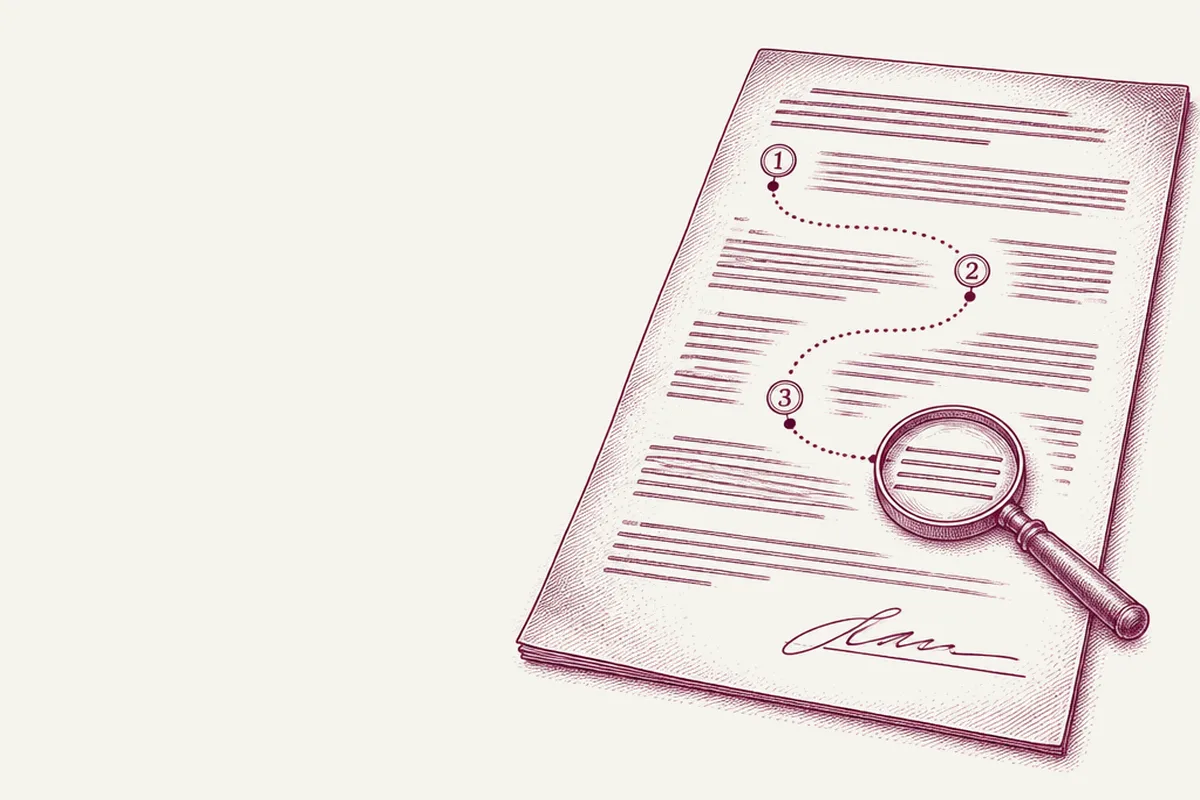
In short: most AI rules are still soft law, so the contract does the regulating. Trace the data from upload to deliverable, then read five clauses closely: the indemnity, training and retention, the order form, the change clause, and how an agent's actions are classified. In the Gulf, data protection law fixes some terms before the negotiation starts.
General legal information, not legal advice. Vendor terms change often: the terms quoted below are as published when we read them in November 2026, so check the current version before you rely on them.
Lawyers in the Gulf now sit on both sides of the AI table. Clients ask them to negotiate the AI deal: a bank buying a chatbot, a retailer licensing a model, a startup selling an agent. And the firm itself buys AI tools, which means someone has to read the vendor's terms before client files go in.
Both jobs start in the same place. Not with the price, and not with the demo. With the data.
The short answer
- The contract does most of the regulating. Binding laws and treaties have never been more than about 7% of the AI measures recorded since 2023, and in 2026 they are around 4%, according to Raymond Sun's Global AI Regulation Tracker. Until that changes, the allocation of AI risk between two businesses is a matter of contract.
- Follow the data. Trace it from upload, through processing, to output and to the final deliverable. At each step ask who consented, what use is allowed, what could infringe, and whether it is secure.
- Five clauses carry most of the risk: the indemnity, training and retention, the order form, the change clause, and how an agent's actions are classified.
- In the Gulf, add the transfer rules. Saudi Arabia's standard contractual clauses become invalid if you modify them. The DIFC expects risk to be assessed before AI processing begins.
Why the contract is where the rules live
The EU AI Act gets the headlines, but most of what governments have published on AI is guidance, principles and frameworks. Sun, a technology lawyer who negotiates these deals on both the vendor and customer side, puts the binding share at around 4% in 2026.
That leaves a gap, and contracts fill it. When a model gets something wrong, leaks a document or infringes someone's work, the first question is rarely "what does the regulation say?" It is "what did we sign?"
His most useful observation for anyone reading these deals: about 80% of the issues are the ones you already know from SaaS contracts, such as service levels, data protection, termination and warranties. The other 20% is where AI is different: training, outputs, agents and token pricing. That 20% is where this guide spends its time.
Follow the data: the four questions
Draw the path the data takes. For a typical legal or business AI tool, it has four stops.
| Stop | What happens | Ask |
|---|---|---|
| 1. Upload | A user puts in a prompt, a file, a client record | Do we have the right to share this? Did the data subject or client consent to this use? |
| 2. Processing | The vendor's system, and often a third-party model, works on it | Where is it processed? Is it kept? Can it be used for training? Who else can see it? |
| 3. Output | The tool returns text, code, a score or an action | Could it infringe someone's rights? Who is responsible if it is wrong? |
| 4. Deliverable | The output goes into advice, a contract or a decision | Is a human checking it? What happens if a client relies on it? |
Every hard clause in an AI contract is an answer to one of these questions. If you cannot draw the path, you are not ready to negotiate the clauses.
Easy deals and hard deals
Two variables decide how hard a negotiation will be. Sun frames them as how sensitive the customer's data is, and how much control the vendor has over the model.
| Vendor trained its own model | Vendor wraps someone else's model | |
|---|---|---|
| **Low-sensitivity data** | Easiest. The vendor can stand behind its model, and there is little to protect. | Manageable. Limited indemnity, but limited exposure. |
| **Sensitive data** (personal data, client files, valuable IP) | Workable. Strong protections are available if you ask. | Hardest. The customer needs the most, and the vendor can promise the least. |
The bottom-right box is common in legal tech. A firm uploading privileged files into a tool built on a third-party model is in it. Know which box you are in before the first call.
Five places the risk hides
1. The indemnity: whose model, whose promise
A vendor can only give a strong IP indemnity if it controls what the model was trained on. A lab that pre-trained its own model may indemnify against third-party IP claims. A vendor wrapping someone else's model has less room, because it cannot see what went in.
Read the exclusions as carefully as the promise. Anthropic's commercial terms, as published when we read them on 6 November 2026, cover third-party IP claims arising from the customer's paid use of the services and the outputs of that use. They do not apply where the claim comes from the customer's own modifications, from combining outputs with technology Anthropic did not provide, or from inputs the customer supplied. Those exclusions are standard and sensible. They also mean that once your team edits an output and drops it into a client document, the indemnity may no longer reach it.
Ask: who built the model underneath? Does that provider's indemnity flow down to us, and in writing? Which of our normal workflows fall inside the exclusions?
2. Training and retention
This is the clause clients ask about first. Some providers now say it plainly. Anthropic's commercial terms state that it "may not train models on Customer Content from Services." Consumer terms are often different from enterprise terms, so check which ones your users actually accept when they sign up.
For law firms the duty is not new. In its Formal Opinion 512 on generative AI (July 2024), the American Bar Association said that before submitting client data to an AI tool, lawyers should review its privacy policy, terms of use and all contractual terms. The ABA does not regulate Gulf lawyers, but no regulator anywhere has said the opposite.
Ask: is training on our data off by contract, not just by a setting? How long are prompts and files kept, and where? Are logs kept for abuse monitoring, and who can read them?
3. The order form
Standard terms are often reasonable. The surprises sit in the order form or the statement of work, which is usually reviewed by the business team, not by lawyers. Two patterns to look for: a generous token discount offset by a take-or-pay minimum spend, and order form terms that quietly override the standard terms.
Ask: does the order form say it prevails over the master agreement? If so, read it as a contract, not an invoice.
4. Terms that change after you sign
AI vendors ship new products every few weeks, and their terms move with them. Many reserve the right to update terms posted online. Anthropic's commercial terms, for example, take effect 30 days after updates are posted or notice is given, and changes made because of a change in law apply immediately.
That is a fair position for a vendor serving thousands of customers. It is a risk for a customer whose workflow depends on the tool, because switching is hard once the tool is embedded. Sun notes that customers respond by asking for notice of adverse changes with a right to exit, and by pulling the online terms into the enterprise contract with that contract taking precedence.
Ask: what changes can the vendor make without us agreeing? Do we get notice and an exit if a change hurts us? Which document wins if they conflict?
Essayer HAQQ AI gratuitement
Découvrez la rédaction et la recherche juridique par IA
5. When an agent acts: output or service?
Chatbots produce text. Agents send the email, file the form, update the record. That changes the liability question.
Sun puts it precisely: is an agent's action an "output" or a "service"? Outputs usually sit under disclaimers that make the customer responsible for how they are used. Services carry a standard of care from the vendor. Among the major vendors, he has seen only Google state explicitly that an action is a service. The others stay silent, presumably to keep flexibility.
Silence is a drafting choice. If a client is buying an agent that will take steps in the real world, the contract should say which category those steps fall into, what standard of care applies, and what the customer must do (approvals, limits, monitoring) to keep the vendor's protection.
Ask: does the contract define agent actions? Is there a human approval step for actions above a threshold? Who pays if an action was taken correctly according to the instructions, and the instructions were wrong?
The Gulf overlay
The five clauses apply anywhere. In the Gulf, data protection law adds hard edges that a contract cannot negotiate away.
Saudi Arabia. SDAIA's amended Personal Data Transfer Regulations, issued on 1 September 2024, list the appropriate safeguards for transfers outside the Kingdom: standard contractual clauses, binding common rules and a certificate of accreditation. Any modification of the standard contractual clauses makes them invalid, and other contract terms must not conflict with them. So if an AI vendor processes Saudi personal data abroad and relies on the clauses, the clauses go in as published. Negotiate around them, not through them.
DIFC. Regulation 10 of the DIFC Data Protection Regulations covers personal data processed through autonomous and semi-autonomous systems, which includes AI. It is designed so that the parties that deploy or provide those systems assess, document and mitigate privacy risks before the processing starts. Most obligations fall on the "deployer", the party in the position of a controller. In a contract, that means the customer cannot simply pass the duty to the vendor. It can require the vendor to supply what it needs to comply: documentation, notice to users about the technology, and cooperation with audits.
UAE federal law. Under the UAE's Personal Data Protection Law (Federal Decree-Law No. 45 of 2021), cross-border transfers are allowed to jurisdictions with an adequate level of protection, and in listed cases where that level is absent. Map the vendor's processing locations, including its model provider's, against those rules before signing.
The clause checklist
| Clause | What to look for | Why it matters |
|---|---|---|
| IP indemnity | Who gives it, what it covers, the exclusions | A wrapper's promise is only as good as the model provider's |
| Training and retention | Training off by contract, retention period, log access | Client confidentiality and data subject rights |
| Order form | Precedence, minimum spend, override language | The real terms often sit here |
| Change clause | Notice, adverse change exit, precedence of signed terms | Stops the deal changing after signature |
| Agent actions | Output or service, standard of care, approval thresholds | Decides who pays when an agent gets it wrong |
| Data transfer | Saudi SCCs unmodified, DIFC Regulation 10 duties, UAE PDPL transfer basis | Some terms are set by law, not by negotiation |
Where HAQQ Legal AI fits
Disclosure: we build HAQQ. The first read of an AI vendor contract is pattern work: find the indemnity, list the exclusions, flag the change clause, compare the order form with the master agreement. HAQQ Legal AI does that first pass in English or Arabic, against the jurisdiction you name, and returns a clause-by-clause review you can check against the text.
We apply the same tests to ourselves. HAQQ never trains on your data. That commitment is on our security page, and it belongs in the contract, not only on a page.
The judgment calls stay with you: which box the deal sits in, what the client can live with, where to push. That is the part of the negotiation that is still legal work.
If you want to see a vendor contract reviewed on your own matter, book a 20-minute demo.
Key takeaways
- With binding AI law still around 4% of measures, the contract is where AI risk is allocated.
- Start every review by tracing the data from upload to deliverable.
- Sensitive data plus a vendor that does not control its model is the hardest deal. Know your box.
- Read indemnity exclusions, order forms and change clauses as closely as the headline promises.
- Make the contract say whether an agent's action is an output or a service.
- In Saudi Arabia, DIFC and the UAE, some terms are fixed by data protection law. Build around them.
Sources and further reading
- Raymond Sun, "How AI contracts are negotiated", Ctrl+AI+Reg, 31 Oct 2026
- Anthropic, Commercial Terms of Service
- National Law Review, "American Bar Association Issues Formal Opinion on Use of Generative AI Tools"
- Mayer Brown, "Updates to Saudi Arabia's Personal Data Protection Regulations: SCCs, Guidelines and More" (Oct 2024)
- Clyde & Co, "Regulation 10 of the DIFC Data Protection Law" (Jan 2026)
- Baker Botts, "DIFC Addresses Autonomous and Semi-Autonomous Data Processing" (Oct 2023)
- US International Trade Administration, "United Arab Emirates allows cross-border data flows of personal data"
- DIFC Commissioner of Data Protection, Regulation 10
- HAQQ: Buying legal AI in the GCC, 4 questions to ask every vendor
- HAQQ: 45 red flags when evaluating a legal AI vendor
- HAQQ: AI and client confidentiality