In short: we counted every click in 61 workflows across two practice management systems, by hand, on the same day. The totals came out close. That turned out to be the least interesting thing we learned. The number that predicts whether software feels fast is not how many clicks an action takes, it is how many places you can start it from.
Every firm evaluating practice management software runs the same demo. A salesperson creates a matter, adds a task, starts a timer, produces an invoice. Everything looks fine, because a demo is a rehearsed path through a product by someone who knows where everything is.
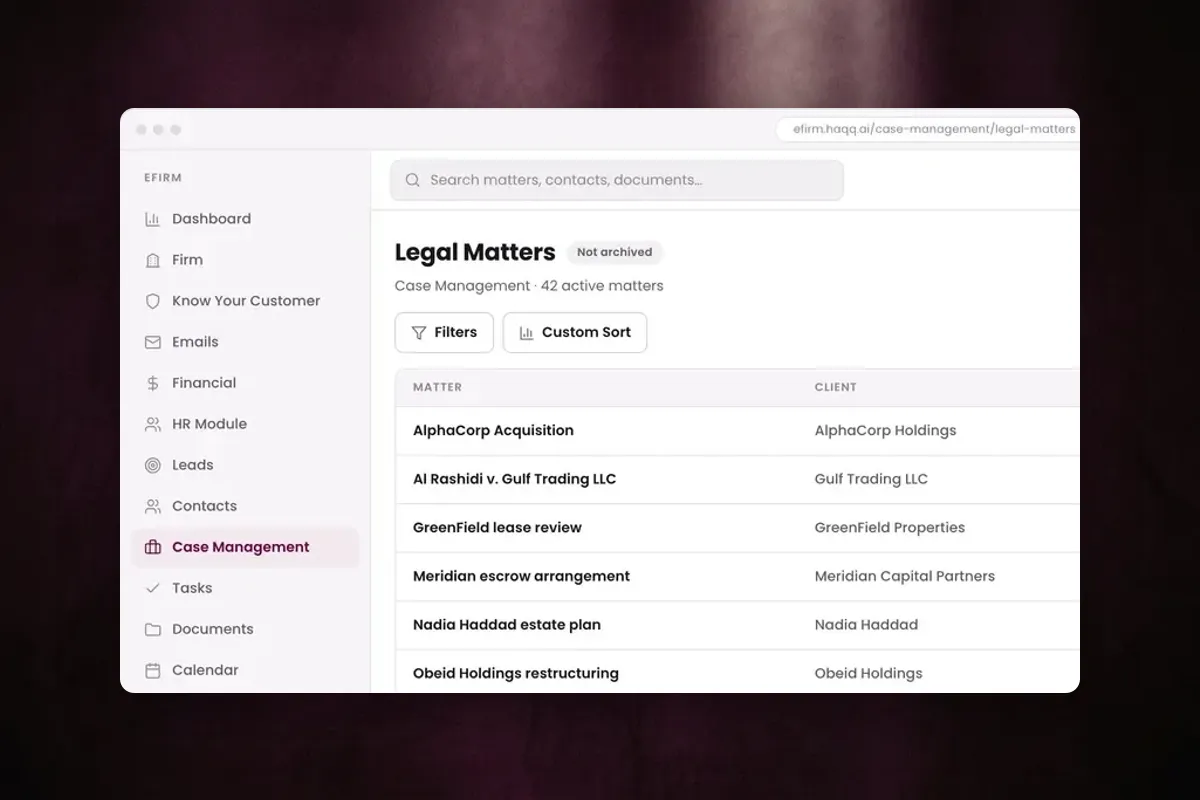
So we tried to measure the thing a demo hides. We took 61 ordinary workflows, the ones a lawyer or an assistant actually repeats every week, and executed all of them in two products: our own practice management system, eFirm, and Clio Manage, which is the system most firms benchmark against. Same day, same protocol, same person counting.
How we counted
One click is one click. Opening a dropdown counts. Choosing the option inside it counts again. Opening a three dot menu counts, and picking the action from it counts. Typing does not count, though we recorded how many fields we had to fill separately.
We also separated two things that usually get mixed together: the clicks it takes to find a feature the first time, and the clicks it takes to use it once you know where it lives. Those are different problems with different fixes, and averaging them together hides both.
The honest limits of this exercise: one login on each product, one day, one screen size, and a Clio trial on its EU Premium tier. That means we did not see how either product behaves under a different role, at a different subscription tier, or with the client's side of anything. Treat every number below as a measurement of that setup, not a law of nature.
What the counts actually said
Across the 45 workflows that were comparable on both sides, eFirm needed fewer clicks in 14, the same number in 20, and more in 11. Here is the shape of it, with Clio's counts normalised so both products are measured from the same starting point.
| Workflow | eFirm | Clio Manage |
|---|---|---|
| Create a matter | 7 | 11 |
| Create a task | 3 | 6 |
| Create a folder | 2 | 4 |
| Add a court date | 6 | 8 |
| Upload a document to a matter | 2 | 3 |
| Find overdue work | 1 | 2 |
| Close or archive a matter | 3 | 4 |
| Add a contact | 8 | 5 |
| Log time against a matter | 7 | 5 |
| Add an expense | 7 | 4 |
| Bill unbilled time, once set up | 7 | 2 |
Read the bottom four rows before the top seven. They are the ones that taught us something.
The number that actually matters
Creating things is faster in eFirm. Recording money against a matter is faster in Clio. When we looked at why, the answer was not interface density or button placement. It was a structural question: can this action begin from the record you are already looking at?
In Clio, a matter page carries its own money. Unbilled time, outstanding balance and client funds sit at the top, and the actions that change them start right there, with the client, the currency and the rate already filled in. So billing feels quick, not because the clicks are cheap, but because you never leave.
In eFirm, creating a record is a light modal with two required fields, which is why matters, tasks and folders come out ahead. But time and expenses have historically been entered from their own modules, which means context you already had gets re-selected. Same clicks on paper. Different experience on a Tuesday afternoon.
Click count measures the distance between two points. It tells you nothing about whether you had to leave the room.
Breadth did not cost what we assumed
Going in, we expected the more feature-dense product to be the slower one. eFirm ships more modules than Clio Manage does, including a full double-entry ledger, HR, KYC questionnaires and sanctions screening, and a firm-configurable navigation. The received wisdom is that this kind of breadth has to make routine work heavier.
It did not. The count was close, and creation was consistently lighter. What breadth cost was not speed but orientation: more places a new user can look in the wrong order. That is a navigation and defaults problem, and it is a very different thing to fix than a slow workflow.
Where each system is genuinely stronger
Clio has been building this category for a long time and it shows in two places in particular. Its billing workflow is deep, with approval states, reminders, rate tables and standard billing code support. Its document layer has real version history, locking and full text search inside file contents. If those are the constraints that decide your purchase, that is a serious product and you should weigh it seriously.
What eFirm does differently is model litigation rather than adapt to it. A hearing is its own record, with court, judge, case number, representing contact, opposing party, participants, attendance, and a reschedule reason drawn from a list your firm defines. It cannot exist without a matter, because in practice it never does. Court Reviews and Service Logs are separate records for the same reason. If your week involves a courtroom, that distinction shows up every day.
The second difference is packaging. In this category, intake, ledger accounting, document automation and legal research are usually separate products with separate prices, several of them quote-gated. eFirm ships them in one subscription with per-seat pricing published on the page. Consolidation is a trade rather than a free win, and the honest version of the trade is that specialists are ahead of us in places. Billing workflow is the clearest one, and we are working on it.
Four questions worth asking any vendor
- Open a matter and ask what it tells you. Does it show the state of the case, the money, and the next thing due? Or is it a form you have to read to find out?
- Pick your most repeated action and ask where it can start. Logging time, adding a disbursement, raising an invoice. If it can only start from its own module, you will pay for that every day.
- Ask how a court date is stored. If the answer is a calendar event with a custom type, the system was built for transactional work and adapted for litigation.
- Ask what is a separate purchase. Intake, accounting, research and drafting are frequently priced apart. Get the whole number before you compare it with anything.
None of these need a spreadsheet. They take about ten minutes of a demo, and they are hard to answer vaguely.
What we changed after counting
Running this on our own product was uncomfortable in the useful way. It told us that our biggest opportunity is not making workflows shorter, because they already are. It is making the matter the place work starts, so that the actions a lawyer repeats can begin from the record instead of from a module. That is the work we are doing now.
It also produced a list of things we do not yet do, and we would rather you hear those from us than discover them in week one. If you are evaluating eFirm, ask us directly what is missing. We will tell you.
- Clio vs HAQQ, feature by feature
- What eFirm replaces, and what it does not
- eFirm, the practice management layer
- Traditional practice management, compared
Vyzkoušejte HAQQ AI zdarma
Zažijte sepisování a rešerše s podporou AI